 EN
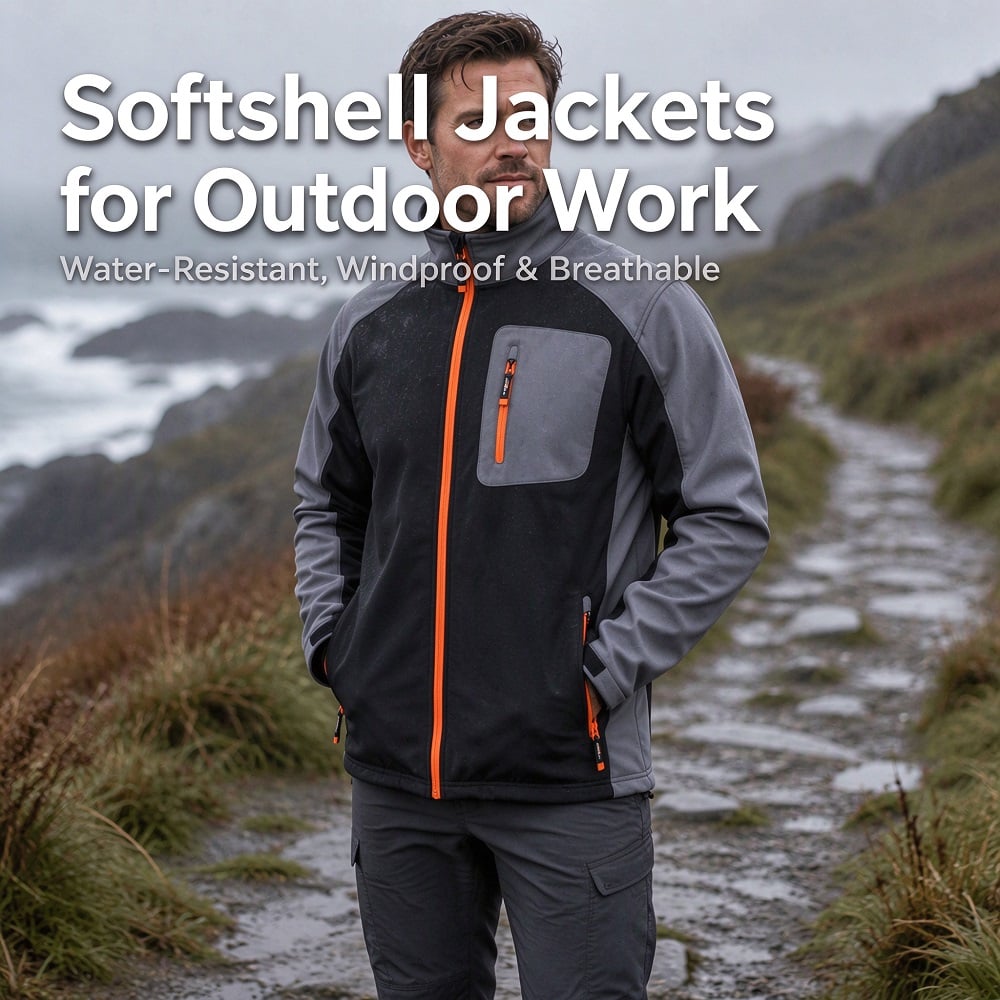
A softshell jacket built around two qualities matters most for outdoor work: it resists water and wind, and the fabric stays breathable. That combination is harder to get right than it sounds, and it is the reason softshell has become a standard layer for crews who work outside.
This guide explains what those two features actually mean on a jobsite, how a softshell jacket fits into a workwear program, and what to check before you spec one for your crew or your brand.
What "resistant to water and wind" means, honestly
"Resistant" is not "waterproof." That distinction matters when you are sourcing workwear, because it changes how the garment should be used.
- Wind resistance keeps cold air from cutting through the fabric and stripping the warm air trapped against your body. On a jobsite, wind is what makes a mild cold day feel brutal.
- Water resistance (usually a durable water-repellent / DWR finish) makes light rain and drizzle bead off the surface instead of soaking in. It is not designed for sustained heavy rain — that is the job of a hard shell.
So a softshell jacket is the right tool for changeable, showery conditions where a crew needs wind protection and light-rain coverage without overheating. For steady downpours, layer it under or swap to a fully waterproof shell.
The breathability trade-off, and why it is the real test
The hard part of any weather-resistant fabric is breathability. If a fabric keeps water and wind out but traps moisture, a working person sweats, and the sweat-soaked base layer pulls heat off the body. That defeats the purpose of wearing a jacket at all.
A breathable softshell is designed so the fabric lets moisture vapour escape while still blocking wind and light water. In practical terms, that means a worker can wear it during active jobs — lifting, climbing, moving — without stewing inside. Breathability is the difference between a jacket a crew keeps on and one they shrug off.
Where softshell fits: the softshell layer
Softshell is typically worn as the outer layer over a base and mid layer during cooler months, or as a standalone over a base layer when it is mild but windy. On outdoor workwear programs, it slots between a fleece mid layer and a hard shell:
Garment |
Role |
When you reach for it |
Base layer |
Moisture management |
Always in cold-weather work |
Fleece / thermal |
Trapped-air insulation |
Still, cold conditions |
Softshell jacket |
Wind + light-water barrier that breathes |
Active outdoor work, changeable weather |
Hard shell |
Heavy rain / prolonged exposure |
Steady downpours, harsh exposure |
Because a softshell moves with the body and breathes, it is well suited to work that combines movement with exposure — site supervision, field service, utility crews, and outdoor trades.
What to check before you spec it in bulk ?
- Fit over layers — confirm the cut works over a base and mid layer; order sizing samples across the full range.
- Closure details — a full front zipper with a storm flap and adjustable cuffs keeps wind out where it usually enters.
- Movement — softshell should not bind in the shoulders and back; test reach during a sample review.
- Hi-vis or FR requirements — if the site demands high visibility or flame resistance, confirm the version carries the required rating.
- Wash durability — ask how the water-repellent finish holds up to industrial laundering and whether it can be re-applied.