 EN
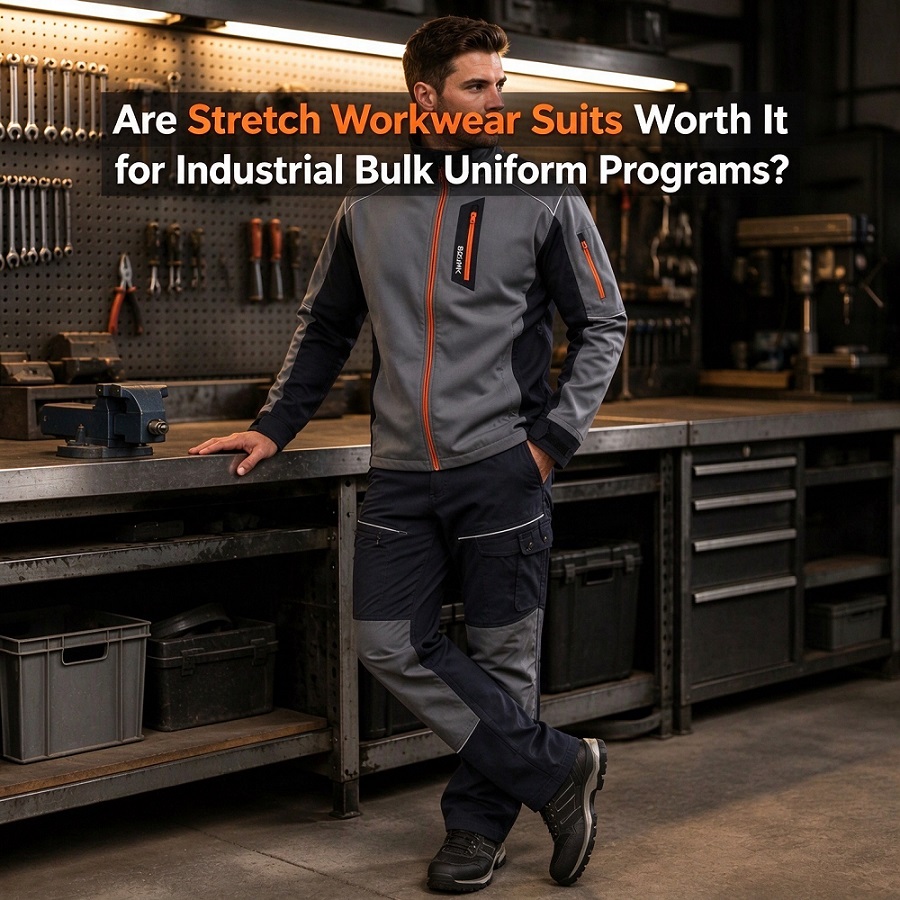
For uniform procurement managers evaluating industrial workwear upgrades, this is one of the most common decision questions: are stretch workwear suits worth the premium over standard rigid uniform sets? For teams in high-mobility industrial roles, the short answer is yes — but only when the suit is built to industrial-grade standards, not fashion-grade stretch. Based on 20+ years of bulk uniform production data and field performance tracking across 30+ global industrial clients, this guide breaks down the real costs, benefits and tradeoffs of nylon spandex stretch workwear suits to help you make a data-backed bulk purchase decision.
The Core Cost Case For Stretch Workwear Suits
The biggest objection to stretch workwear suits is higher upfront unit cost, but this view almost always ignores total cost of ownership. For active industrial roles, standard non-stretch uniforms fail at predictable stress points — seams split, knee fabric wears through, and shape loss forces replacement long before fabric actually wears out.
Our field tracking data shows that standard workwear sets last an average of 4–5 months in construction, field maintenance and warehousing roles. A quality industrial stretch workwear suit extends that service life to 8–10 months by eliminating most common premature failure modes. Double the service life means nearly half the annual purchase volume, which typically offsets the 15–20% upfront price premium within the first 12 months of use. When you add in reduced administrative work for ordering, receiving and distributing uniforms, the total cost savings are even higher.
3 Unique Advantages of a Matched Stretch Workwear Suit
Stretch workwear suits deliver benefits that mixing separate stretch jackets and trousers cannot match, especially for large uniform programs.
First, consistent performance across the full uniform. When both pieces use the same nylon spandex blend and the same reinforcement standards, there is no weak link in protection. A matched stretch workwear suit ensures equal tear strength, abrasion resistance and stretch recovery from collar to ankle, rather than having one piece wear out twice as fast as the other.
Second, optimized functional coordination. Pocket layouts, tool loops and storage features on the jacket are designed to complement trouser pocket positions, creating a logical storage system for tools and work essentials. This reduces wasted movement and improves on-the-job efficiency for workers who carry equipment through shifts.
Third, unified brand and safety visibility. A coordinated stretch workwear suit creates a clean, consistent team appearance with matching colors and aligned branding placement. For customer-facing field teams and on-site contractor crews, this professional image strengthens perceived credibility and reinforces safety culture.
When Stretch Workwear Suits Are Not the Best Choice
To be fully transparent, stretch workwear suits are not ideal for every industrial role. There are two scenarios where standard workwear delivers better value.
First, extreme high-heat and open-flame roles such as welding and foundry work. Nylon spandex blends have lower melt resistance than pure cotton or flame-retardant fabrics, and are not suitable for work with continuous open flame or high radiant heat. For these roles, flame-resistant non-stretch suits remain the safer choice.
Second, low-mobility sedentary roles such as control room operators and desk-based site staff. For workers who sit for most of the shift, the mobility benefit of a stretch workwear suit rarely justifies the price premium. Standard durable workwear sets deliver sufficient performance at a lower cost.
For all other active industrial roles — including construction, logistics, field maintenance, manufacturing and facility management — quality stretch workwear suits almost always deliver positive ROI over a 12-month period.
How to Ensure You Get a Genuine Industrial-Grade Stretch Workwear Suit
Not all stretch workwear suits deliver the performance outlined above. Many low-cost options use fashion-grade stretch fabric that bags out quickly and tears easily in industrial conditions. Use these four checks to qualify suppliers before placing bulk orders.
First, verify fabric composition and quality. Industrial-grade stretch workwear suits typically use a 92% nylon / 8% spandex blend for heavy-duty roles, or a 97% cotton / 3% spandex blend for general indoor use. Avoid suits with more than 10% spandex — they lose shape rapidly and have poor abrasion resistance. Request stretch recovery test data: quality suits retain 85%+ of original dimensions after 50 stretch cycles.
Second, confirm reinforcement construction across both pieces. A proper industrial stretch workwear suit will have double-stitched main seams, bartack reinforcement at all pocket openings and stress points, and targeted knee and elbow reinforcement panels. If only the trousers have reinforcements and the jacket does not, it is not a true matched industrial suit.
Third, check certification and compliance. Reliable industrial stretch workwear suits meet EN ISO 13688 general protective workwear standards and use OEKO-TEX Standard 100 certified fabric. For high-visibility variants, verify EN ISO 20471 compliance. Suppliers should be able to provide third-party test reports for all performance claims.
Fourth, evaluate supplier track record. Look for manufacturers with at least 15 years of industrial workwear experience, proven bulk production capacity, and a client list of established industrial brands. This reduces the risk of quality inconsistency across large repeat orders.
Final Verdict
For active industrial teams, a properly built industrial stretch workwear suit is almost always worth the investment when evaluated on total cost of ownership rather than upfront unit price. The extended service life, reduced replacement frequency and improved worker comfort deliver measurable cost savings and productivity benefits for most high-mobility roles. The key is to select a true industrial-grade suit with verified performance data, not a fashion-stretch product marketed as workwear.
If you have high-mobility teams and your current uniforms need replacing every 6 months or less, upgrading to a quality nylon spandex stretch workwear suit will almost certainly reduce your annual uniform costs while improving worker satisfaction.
Explore our range of industrial-grade stretch workwear suits with full performance test data, or contact our team for a custom cost comparison based on your workforce size and role mix.