 EN

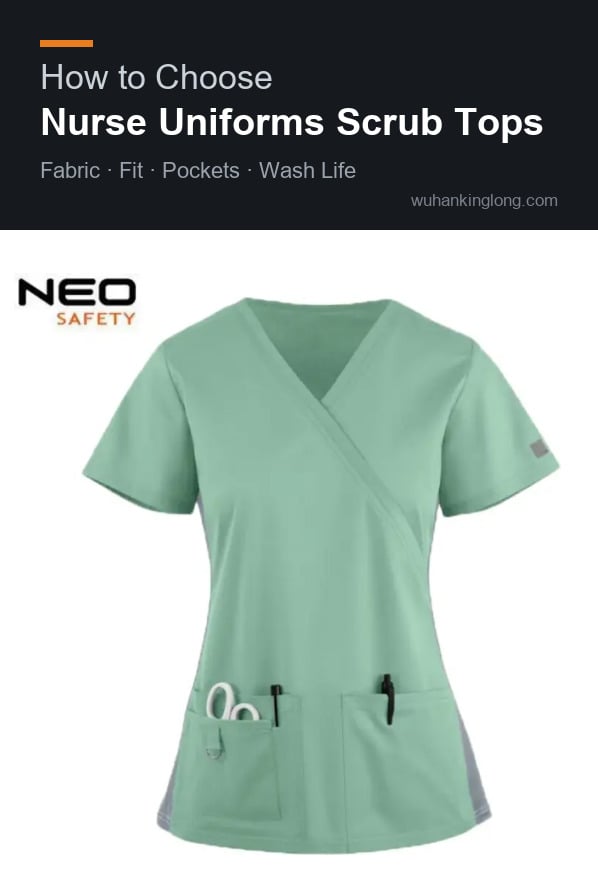
Nurse uniforms scrub tops are the piece staff actually live in for twelve hours. The trousers stay on; the top takes the stitches, the pen marks, the hand sanitiser and the scrutiny. Yet most orders for nurse uniforms scrub tops start with a colour swatch and a price, and the spec conversation never happens.
That's backwards. A scrub top is a replaceable SKU with a wash life, a size curve and a pocket layout. Get those four things wrong and a cheap shirt becomes an expensive reorder. Here's how we'd spec nurse uniforms scrub tops before a first bulk order, and what to ask the supplier for at each step.
1. Start With the Fabric, Not the Colour
Fabric decides comfort, wash life and how the nurse uniforms scrub tops look after fifty cycles. Colour is the last decision, not the first.
Most nurse uniforms scrub tops use a poly-cotton blend, often 65/35. Cotton gives breathability against skin; polyester holds shape and shrinks less under industrial washing. A cotton-rich blend feels softer but wrinkles and shrinks more. A performance blend with a little elastane moves better on a long shift, though you should check how that stretch survives high-heat laundry before you specify it.
Ask for the scrub top fabric composition, the GSM and the shrinkage figure after a stated number of washes. If a supplier can't give a test result, treat the fabric claim as marketing. For material safety, ask whether the fabric and trim carry OEKO-TEX Standard 100 certification, and check the scope covers the components you actually receive.
2. Fit the Top to the Shift, Not the Size Chart
A nurse uniforms scrub tops range fails on fit more often than on fabric. The cut has to work when someone reaches, bends and lifts, not just when they stand in a fitting room.
The v-neck scrub top is the default in most wards because it layers over an undershirt and clears the throat. A mock-wrap or round neck suits staff who want more coverage. Set the cut across a real size curve, not one sample size: XS through 3XL as a starting point, with petite and tall lengths if your headcount needs them. Unisex cuts cut inventory; gendered cuts fit some roles better. Confirm which one your departments actually want.
The test is simple. Put the nurse uniforms scrub tops on three staff of different heights, then ask them to raise both arms, reach a top shelf and sit down. The hem should stay put and the shoulder seam should sit on the shoulder. If the top rides up when the arms go overhead, the pattern is wrong regardless of the label size.
3. Pockets Decide Whether the Top Gets Used
Pocket layout is the detail nurses notice first and spec sheets list last. A nurse uniforms scrub tops design with shallow pockets loses pens and badge reels inside a shift.
Specify two deep lower pockets and one secure chest pocket at minimum. Check pocket depth with a real phone and a pen, not a ruler. Bar-tack the stress points at pocket corners, because that's where nurse uniforms scrub tops split first under laundry and movement. If a department carries shears or a small instrument, add a dedicated slim pocket rather than expecting staff to improvise.
Ask for the scrub top pockets to be placed clear of the hip belt and any equipment worn over the top. A pocket you can't reach with a stethoscope around your neck is decoration. Confirm the position on a physical sample before bulk, not on a flat drawing.
4. Colour Coding Needs a Continuity Clause
Colour is how a hospital tells roles apart at a glance, so nurse uniforms scrub tops are often ordered by department colour. That makes dye consistency a purchasing issue.
Navy for nursing, teal for theatre, grey for support staff is a common system, but every facility sets its own. Send the supplier a physical colour standard, not a hex code. Ask how they match dye lots across repeat orders, and what tolerance they hold between batches. Two shipments of nurse uniforms scrub tops in the "same" navy that arrive a shade apart will show up in the same ward on the same day.
Put colour continuity in writing as a reorder clause. Ask for a lab dip against your standard and keep a sealed sample. If a future batch drifts beyond the agreed tolerance, you need something concrete to point to. This is where scrub top sourcing quietly saves money on returns.
5. Judge Wash Life by the Cycle Count
Nurse uniforms scrub tops go through industrial laundry, which is harsher than a home wash: higher temperature, stronger chemistry, more cycles. Industrial laundry scrub tops that look fine off the line can fade, pill or lose shape by cycle fifty.
Ask for the wash-test result, not the care label. How many cycles did they test, at what temperature, and what did they measure: shrinkage, colour change, pilling, seam strength? A credible answer names the cycle count and gives a figure. For nurse uniforms scrub tops intended for high-turnover wards, a supplier who has never run a wash test is a risk you'll pay for at reorder.
The same applies to any fluid-repellent or antimicrobial finish. Ask what the finish is, how many washes it lasts and whether it needs reapplication. Ordinary nurse uniforms scrub tops are not a barrier garment. If a department needs certified fluid protection, that's a gown or a different product class, not a finish on a shirt. Under Regulation (EU) 2016/425, ordinary work clothing sits in Category I; anything sold as protective needs a separate conformity route. Don't let a scrub top carry a promise it can't keep.
6. Treat the Top as a Reorder SKU
The first order is the easy part. nurse uniforms scrub tops are a consumable: staff join, sizes change, garments wear out. Plan the reorder before the first shipment lands.
Confirm the MOQ for nurse uniforms scrub tops against your headcount and expected annual turnover, not just the initial intake. Ask whether stock colours carry a lower minimum than custom dyes. Set a size curve you can repeat, agree a lead time that covers a new-hire cohort, and keep a sealed sample and a lab dip on file so batch two matches batch one. A supplier who can hold those three things makes the second order as predictable as the first.
We've made workwear and healthcare uniforms in Hubei for over 20 years, run three million pieces a year under ISO 9001, and hold OEKO-TEX Standard 100 on materials; SGS and ICS audits come from European partners. We'll build scrub top sizing to your headcount, from stock sizes or a graded curve. Our certificate and test report list shows the documents. If you're still deciding between garment formats, our hospital uniforms guide sets out the options, and the scrubs uniforms manufacturing page covers what we can build.
FAQ
What fabric are nurse uniforms scrub tops usually made from? A poly-cotton blend, commonly 65/35. Cotton breathes; polyester holds shape and resists shrinkage. Performance blends add a little stretch. Ask for the composition, GSM and a shrinkage test result before you order.
How should a scrub top fit for a twelve-hour shift? It should let you raise both arms and reach without the hem riding up or the shoulder seam slipping. Test the sample across several heights and body types, not one size.
How many pockets should a scrub top have? Two deep lower pockets and a secure chest pocket is a workable baseline. Check depth with a real phone and bar-tack the stress points.
Do nurse uniforms scrub tops need PPE certification? Ordinary scrub tops are not protective equipment. They fall under Category I of Regulation (EU) 2016/425 as ordinary work clothing. If a role needs a certified fluid barrier, specify a gown instead.
What should I check before reordering a second batch? Confirm the MOQ, agree a repeatable size curve and lead time, and hold a sealed sample plus a lab dip so the dye matches the first shipment.
About the author. Wuhan Kinglong Protective Products (Hubei) Co., Ltd. product team. Over 20 years in workwear and healthcare uniforms, three million pieces a year under ISO 9001, OEKO-TEX Standard 100 on materials, SGS / ICS audits from European partners.