 EN
A waterproof hiking jacket is not a single fabric. It usually combines a DWR-treated face that beads water, a membrane that blocks wind and liquid while passing vapor, a durable outer weave that resists abrasion, and fit details such as an adjustable hood, cuffs and pockets. When you evaluate a shell, ask what membrane it uses, whether the waterproof and breathability figures carry a test method, and how seams and zips are treated. This guide breaks the components down and lists what to check on a sample before bulk approval.
What the waterproof hiking jacket shell contains
The face fabric sits against the weather. It carries a DWR, or durable water repellent, coating that makes droplets bead and roll off instead of soaking straight into the cloth. DWR wears down with washing, dirt and abrasion, so a jacket that beads water when new can wet out later even if the membrane underneath still holds.
The membrane sits between the face fabric and the backer or lining. It blocks wind and liquid droplets while letting sweat vapor move through. TPU is one common membrane type used in outdoor shells; it balances waterproofing, breathability and hand feel. Membranes differ in stretch, stiffness and how they hold up after repeated washing, so the membrane type matters as much as the rating number.
The outer weave protects the membrane from rubbing, pack-strap friction and kneeling. A light weave feels soft but wears faster on rough terrain; a denser weave lasts longer but can add weight and stiffness. The right balance depends on how the garment is used, not on choosing the heaviest fabric by default.
The waterproof hiking jacket in our line
The waterproof hiking jacket shown in our outdoor range uses a composite fabric at 190 g/m2 with a TPU membrane, a DWR face and an abrasion-resistant, durable outer weave. The mill sheet marks waterproof at 5000 mmH2O and breathability at 5000 g/m2/24h. These are mill figures; the test method and lab are not printed on the sheet, so treat them as a reference point until a report is supplied.
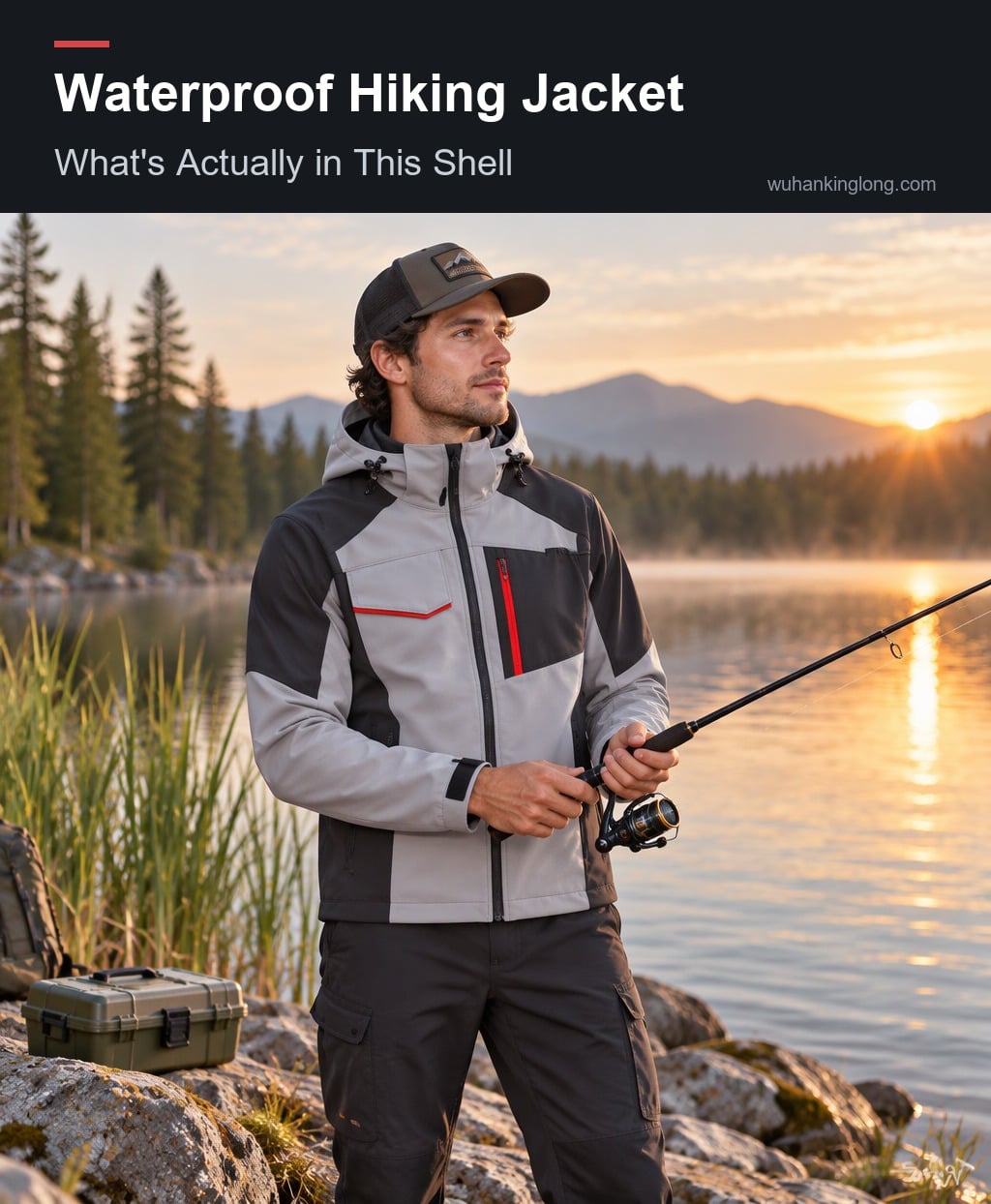
On this waterproof hiking jacket, the cut pairs a grey body with black panels and sleeves, accented by a red binding strip at the back yoke and pocket lines. It carries a flap chest pocket and a vertical zippered chest pocket, two zippered hand pockets, a 3D hood with drawcord adjustment, and hook-and-loop adjustable cuffs. The multi-panel splice leaves room to move across the shoulders. The red binding is a color accent, not a reflective or hi-vis detail.
Reading the ratings correctly
The waterproof figure, measured as hydrostatic head in millimeters, records how much water the fabric holds back before leakage. It does not state breathability, seam sealing or zip performance. The breathability figure, measured as vapor output in grams per square meter over 24 hours, records how much vapor passes through; it cannot be compared directly with an RET resistance number. Windproof is a separate property from waterproofing. When a spec sheet prints a number, check whether the test method and lab are named alongside it.
Common misunderstandings
- A higher millimeter rating means a tougher jacket. The rating measures water holdback only, not durability, fit or breathability.
- The shell keeps the wearer warm by itself. It blocks wind and rain; warmth comes from the base and mid layers worn underneath.
- A colored binding strip makes the jacket hi-vis. Visibility certification requires a tested garment with the required reflective area, not a decorative accent.
- Waterproof means every seam and zip is sealed. Seam treatment and zip construction have to be checked separately on the sample.
Sample inspection checklist
- Membrane and fabric. On the waterproof hiking jacket, ask what membrane and outer weave are used, and feel the stretch at the shoulders.
- Waterproof and breathability figures. Request the test method and lab behind any millimeter or gram number.
- Seam treatment. Check how joined lines are finished where water could enter.
- Zip performance. Look at zip teeth, pull and whether the closure has a water-resistant construction.
- Hood and cuff fit. Adjust over a mid layer and gloves, the way the wearer will actually use it.
- Pocket carry. Load a phone and small items; confirm pockets clear straps and tool belts.
- Care and reproofing. Ask how the DWR should be washed and whether it can be refreshed.
Our side of the order
On our waterproof hiking jacket line, shell, softshell and fleece layers are offered as separate pieces so a program can be built by season and role. Fabric balance, color blocking, pocket layout, logo method and size chart are open for OEM and ODM. Samples run 7 days after spec and color confirmation, bulk 60 days after approval and deposit. We do not state a certified waterproof class or hi-vis level on a garment unless the corresponding report is on file.
FAQ
What is a waterproof hiking jacket made of? A waterproof hiking jacket typically combines a DWR-treated face fabric, a waterproof-breathable membrane, a durable outer weave and fit details such as an adjustable hood and cuffs. The exact membrane and weave should be listed on the spec sheet.
Is a 5000 mmH2O jacket good for hiking? It depends on the conditions and the rest of the build. The 5000 mm figure records water holdback; seam treatment, zips, breathability and fit matter just as much for hiking use. Ask for the test method behind the number.
What is the difference between a waterproof hiking jacket shell and a softshell? A shell leans on membrane protection against rain and wind; a softshell leans on stretch and comfort for active movement. The choice depends on weather, work rate and whether the garment is an outer layer or an active top.
Can the jacket carry our own logo and size chart? Yes. Logo method, blocking, trim color, hangtag and size chart are open under OEM and ODM.