EN
If you source workwear for field crews or training teams, you have likely run into this problem: camouflage suits look sharp in product photos, but tear, fade and fall apart after just weeks of daily outdoor use.
The truth is, good camouflage suits are defined by fabric and construction, not just the pattern. For field work, patrol and tactical training, a well-built set will last 2–3 times longer than a cheap fashion-style camo set, and save you money on replacements over time.
This guide breaks down how to pick durable camouflage suits that hold up to real outdoor conditions.
Fabric: The Foundation of Reliable Camouflage Suits
When evaluating camouflage suits, check fabric quality before you look at the pattern. The right material determines how long the uniform will last through crawling, climbing, brush contact and repeated washing.
1. Ripstop weave is a must for active field use
Ripstop fabric has a reinforced grid structure that stops small snags from turning into large tears. For field work and training, ripstop camouflage suits typically last twice as long as plain weave alternatives. Our WH8704 BDU camouflage suits use polyester cotton ripstop specifically for this reason — it resists thorns, gravel and rough surfaces that would destroy thinner fabric.
2. Polyester cotton balances durability and comfort
Most heavy-duty camouflage suits use a polyester cotton blend. It is tougher than pure cotton, more breathable than full synthetic fabric, and holds up well to weekly industrial washing.
3. Wind and water repellent coating adds practical value
Field work rarely stops for light rain. A durable water repellent finish on camouflage suits will not replace a full rain jacket, but it repels light rain, dew and splashes enough to keep workers dry through short showers and damp morning shifts.
4. Color-fast dye matters for long-term appearance
Cheap camouflage suits often fade noticeably after 5–10 washes. Higher quality sets use color-fast dye that stays consistent through months of regular use and laundering.
Pick the Right Pattern for Your Work Environment
The best camouflage suits match the terrain where your team works. Pattern choice should follow job location, not personal preference.
- Woodland camouflage suits: Green and brown multi-tone prints work best in forested areas, parks, rural fields and vegetation-heavy sites. They are the top choice for forestry crews, landscape teams and rural field technicians.
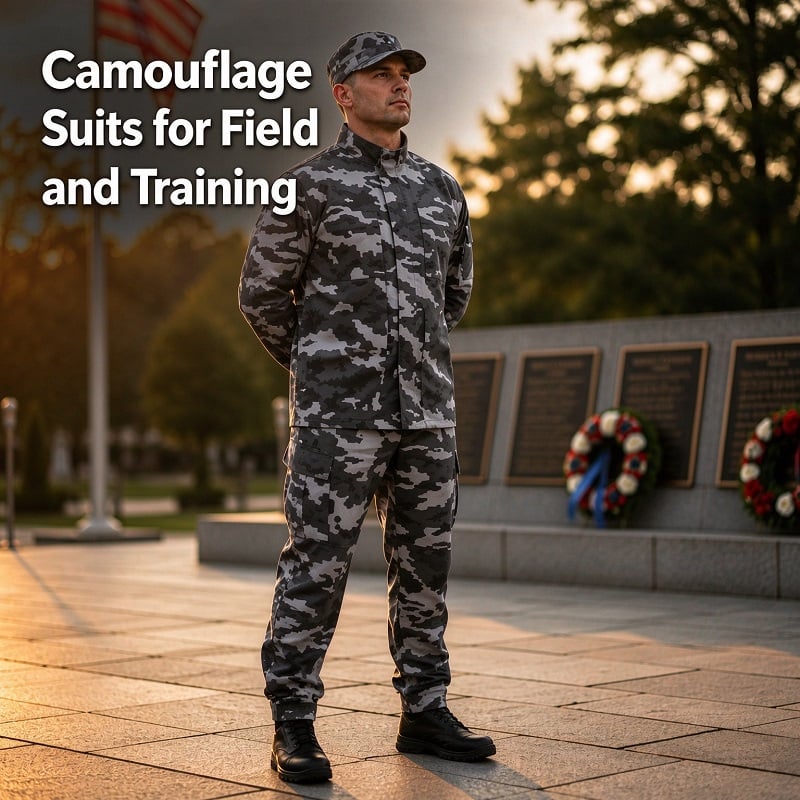
- Urban / digital camouflage suits: Grey and black pixelated patterns blend with concrete, metal structures and low-light conditions. They are ideal for security patrols, industrial yards, warehouse perimeter duty and night shift work.
- Dark low-contrast camouflage suits: Muted dark grey or navy camo works well for mixed indoor-outdoor roles. It offers the durability of BDU construction without a heavy tactical look, making it a flexible pick for facility and yard maintenance teams.
- Desert / arid camouflage suits: Tan and light brown patterns are built for dry, rocky, sandy terrain. They are a niche option, but essential for crews working in quarries, open construction sites and arid regions.
Match Camouflage Suits to Your Team’s Daily Work
Not all camouflage suits are built for the same job. Match the features to what your crew actually does every shift.
- Security and patrol teams: Go for urban camouflage suits with ripstop fabric, multiple cargo pockets and a clean, professional cut. Most patrol teams do not need over-the-top tactical features — they need reliable pockets for radios, ID and notebooks, and a consistent professional appearance.
- Forestry and outdoor field crews: Prioritize woodland camouflage suits with heavy ripstop fabric, reinforced knees and seat, and water repellent treatment. These workers deal with brush, thorns and constant movement, so durability is non-negotiable.
- Tactical training academies: Choose BDU-style camouflage suits with reinforced seams, adjustable cuffs and a relaxed mobility-focused cut. Training environments put uniforms through extreme physical stress, so reinforced stress points separate long-lasting sets from one-season disposable ones.
- Warehouse and yard operations: Dark low-contrast camouflage suits with mid-weight ripstop fabric work best here. The pattern hides dirt and scuffs, and the durable fabric stands up to loading, lifting and frequent movement between indoor and outdoor spaces.
Always order a sample set and have a frontline worker test it for one full week before placing a bulk order. Catalog photos never reveal stiff fabric, shallow pockets or restrictive fit the way real on-the-job use does.
3 Costly Mistakes to Avoid With Bulk Camouflage Suits
- Buying only by price per set The cheapest camouflage suits save money upfront, but they cost more long term when they need replacement every few months. Calculate cost per month of use, not just upfront price.
- Skipping sample testing Photos make every uniform look well made. Thin fabric, poor stitching and bad sizing only show up when you hold and wear a sample.
- Ignoring size range availability Many standard lines of camouflage suits only go up to XL. Confirm extended sizes are available before you commit to a full team uniform rollout.
Care Tips to Make Your Camouflage Suits Last Longer
Simple care habits can add months of usable life to your camouflage suits:
- Wash inside out to protect the camo pattern
- Use mild detergent; skip bleach and fabric softener, which break down water repellent coatings
- Tumble dry on low heat or line dry — high heat fades dye and weakens fabric
- Repair small tears right away before they spread
With proper care, quality ripstop camouflage suits will typically last 12–24 months with regular 5-day-a-week use.
Frequently Asked Questions
Q: How long do good camouflage suits last with regular field use?
A: With proper care, high-quality ripstop camouflage suits last 12–24 months for regular full-time field work. Heavy training or highly abrasive terrain will shorten that timeline.
Q: Can we add company logos to custom camouflage suits?
A: Yes. Embroidery is the most durable option for heavy field use. Screen printing and heat transfer are lower-cost alternatives.
Q: Are ripstop camouflage suits worth the extra cost?
A: For active field work and training, yes. Ripstop fabric prevents small snags from becoming large tears, which drastically extends the uniform’s usable life.
Q: What size range do your camouflage suits come in?
A: Our standard WH8704 camouflage suits run from S to 3XL. Custom extended sizes are available for bulk orders.