 EN

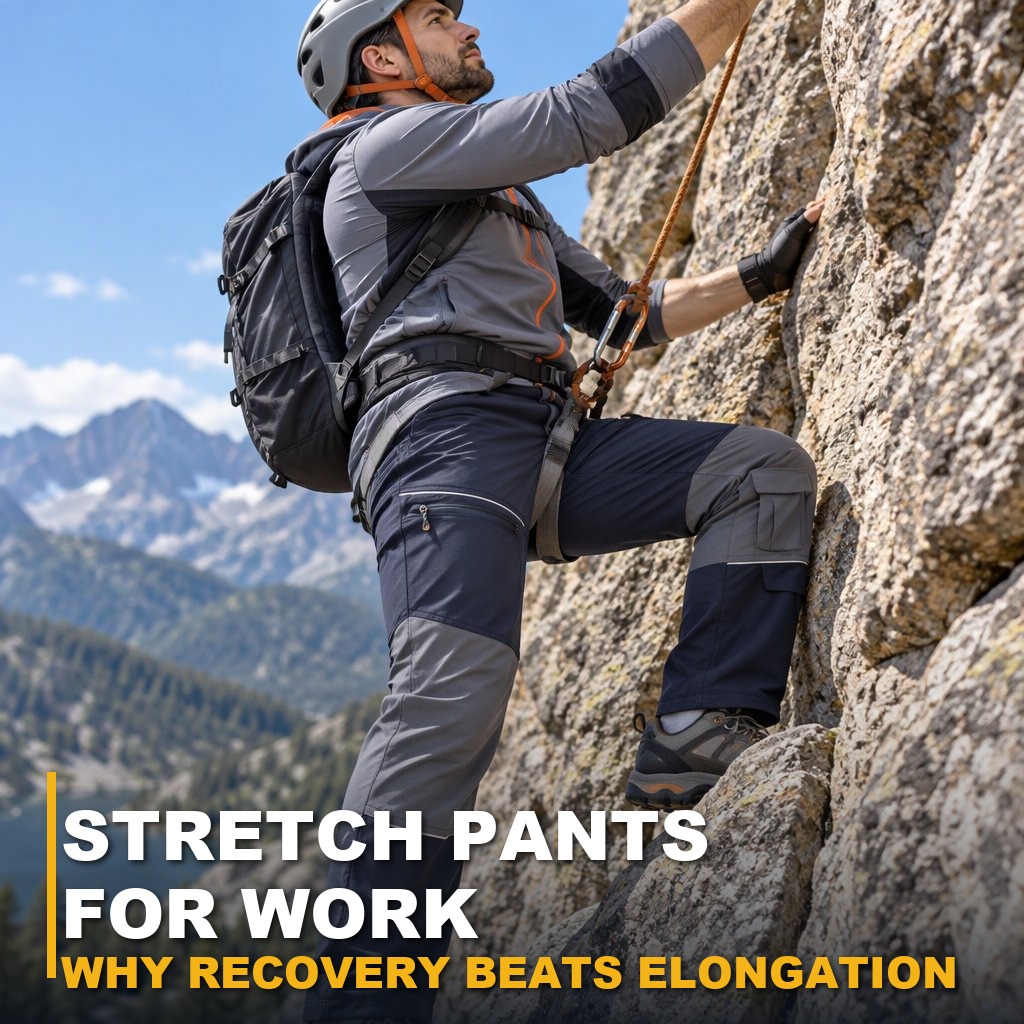
A 2,000-pair order of stretch pants passed the elongation test at 28% and shipped on time. Forty industrial washes later, half the pairs had grown a full size at the knee and seat, and the buyer was replacing trousers instead of reordering them. The cloth had met the number on the specification sheet. Nobody had written down the number that decides whether stretch pants survive a contract: recovery.
Stretch pants are sold on elongation and bought on recovery
Three measurements get confused in every conversation about stretch pants.
Elongation is how far the cloth stretches before it stops. Growth is what is left behind after it relaxes — the extra centimetre at the knee that never comes back. Recovery is what comes back — the figure that decides how long stretch pants last. Stretch pants with 30% elongation and 82% recovery look impressive on a data sheet and bag out in six weeks.
The order of importance is the reverse of the order buyers ask about. For stretch work pants, 20% elongation at 95% recovery beats 35% at 80% every time, because the wearer notices sag, not stretch.
ASTM D2594 measures growth and recovery on stretch fabrics. Ask for the result after five extension cycles rather than one pull, and ask whether the test ran before or after washing. Most stretch pants are tested new and worn washed — a gap that hides most failures buyers complain about.
Elastane or mechanical stretch: the laundry decides
Most stretch pants use elastane, usually 2–5% blended into a cotton or poly/cotton twill. It is cheap, it stretches far, and it has one weakness that matters more in contract than in retail: heat and chlorine destroy it. A tunnel washer at 75–85°C with a chlorine bleach step will take the recovery out of elastane-rich stretch pants long before the cloth abrades through.
Mechanical stretch avoids the problem for stretch pants on a chlorine cycle. Bi-component yarns such as T400, PBT and textured polyester create stretch through yarn geometry rather than an elastic core. They survive bleach, heat and repeated pressing, and they hold shape in stretch pants that pass through a hospital laundry five days a week.
The trade: mechanical stretch delivers 12–20% elongation instead of 25–40%, feels drier and costs more per metre. If your laundry uses chlorine, mechanical stretch is cheaper across three years, and it is the only version of stretch pants that still fits in year three.
Two-way and four-way are different garments
Both labels appear on stretch pants and solve different problems.
| Construction | Elongation | Where it belongs | Watch for |
|---|---|---|---|
| 2-way weft stretch, 2–3% elastane | 15–25% crosswise | Uniform trousers, light service work | Growth at the knee |
| 4-way stretch, 4–8% elastane | 25–40% both directions | Kneeling and climbing trades | Seam elongation, cost |
| Mechanical 2-way (T400) | 12–20% crosswise | Chlorine laundries, heavy wash cycles | Drier hand, price |
| Stretch ripstop | 10–18% | Snag-prone sites, warehousing | Seam slippage |
| Knit stretch (ponte) | 30–50% | Indoor and medical uniforms | Pilling, shape loss |
Four-way stretch earns its price where the wearer squats or climbs; four-way stretch pants sold to a utility crew are a different product from the stretch pants a hotel issues at reception. Two-way weft stretch covers more applications than its reputation suggests, and stretch work pants built on it stay inside a uniform budget.
Stretch pants fail at the seam first
Cloth that gives 25% stitched to a seam that gives 8% makes stretch pants that fail the first time someone crouches. The stitch cracks, needle holes open, and the buyer blames the fabric.
Seam elongation is what stretch pants orders leave off most often. Set it no more than five points below the fabric figure, then agree the construction: four-thread overlock or flatlock with textured polyester thread, never a cotton-core thread that snaps before the cloth does. On stretch pants the seam is part of the stretch system, not a way of joining panels.
Two details separate durable stretch pants from average ones. Bar-tacks at pocket mouths and belt loops on stretch pants, where point loads land. And a needle sized for the cloth — an oversized one leaves perforations the fibre cannot close along every seam.
Stretch pants change the size range you need
Stretch is a sizing tool before it is a comfort feature. A four-way pair of stretch pants covers roughly 1.5 size steps, letting a buyer cut a range from ten sizes to seven and carry less stock. That saving often outweighs the fabric premium, which is why stretch pants sell well into rental contracts.
Two rules protect it. Keep negative ease between 2 and 4 cm so the stretch pants hold shape, and make the waistband stretch with the cloth — a rigid waistband on a stretch body splits at the centre-back seam.
Check the grade on the stretch pants at hip and knee, not only the waist; stretch hides a poor grade in the fitting room and exposes it after twenty washes. Stretch pants cut from a lazy grade fit beautifully at approval and look borrowed a year later.
Where stretch stops: hi-vis and flame resistance
High-visibility stretch pants are straightforward: EN ISO 20471 allows a stretch base fabric. The retroreflective tape does not stretch, and that is where certification is usually lost. Tape applied straight onto a stretch panel lifts at the ends after washing, so the tape on stretch pants has to sit on a stabilised panel, with the stretch routed away from the tape line.
Flame-resistant stretch pants are a different conversation. Elastane melts, and a melting fibre undermines the protection the standard exists to deliver. EN ISO 11612 and IEC 61482 garments generally avoid elastane or keep it to a token percentage inside a modacrylic or aramid blend. Never accept the phrase "FR stretch pants" without a certificate naming fabric, trim and design together.
Test stretch pants before bulk, not after
A wear trial on ten pairs of stretch pants costs less than one air-freighted replacement order. Send the stretch pants through the laundry that will actually process them for five cycles, then measure growth at the knee, growth at the seat, and whether any seam has begun to grin.
Cut the stretch pants sample on the same marker as production: a fit approved on a straight cut will not predict a tilted one.
Five specifications to write on the purchase order
- Elongation, growth and recovery, each with its test method and cycle count.
- The wash cycle used before testing: temperature, chlorine yes or no, number of cycles.
- Seam elongation as a percentage, with the stitch type named.
- Growth after five cycles, capped at 2%.
- Care label wording that matches the laundry the garments will actually enter.
Buyers who write those five lines get stretch pants that keep their shape for the life of the contract. Buyers who write "4-way stretch, 260 gsm" get a data sheet, a claim, and stretch pants that bag at the knee.
FAQ
What percentage of elastane should stretch pants have?
2–3% suits uniform trousers and light service work; 4–6% suits trades that kneel and climb. Above 8% in a woven stretch work pant buys comfort the wearer pays for in shape loss, because high-elastane stretch pants recover more slowly after every hot wash.
How many industrial washes do stretch pants survive?
Expect measurable growth in elastane stretch pants between 30 and 50 industrial cycles, and later in mechanical stretch. Treat both as a starting point and test the cycle your own laundry runs — temperature and chlorine move the figure more than the fabric does.
Can hi-vis stretch pants keep their certification?
Yes, if the tape on stretch pants sits on a stabilised panel rather than directly on the stretch cloth. Tape on a stretch panel lifts at the ends, and the garment then fails EN ISO 20471 on tape adhesion, not on the base fabric.
Why do stretch pants bag at the knee?
Three causes, in order: insufficient recovery in the cloth, a seam that cannot follow the stretch, and a pattern with no knee shaping. Heavier fabric hides the first two in year one and makes them worse in year two.
Are stretch pants suitable for flame-resistant workwear?
Only with certification covering the finished stretch work pants. The fibre melts, so FR stretch pants normally use a modacrylic or aramid blend with little or no elastane. Ask for the certificate naming fabric, trim and design, and confirm it covers your colour.