 EN

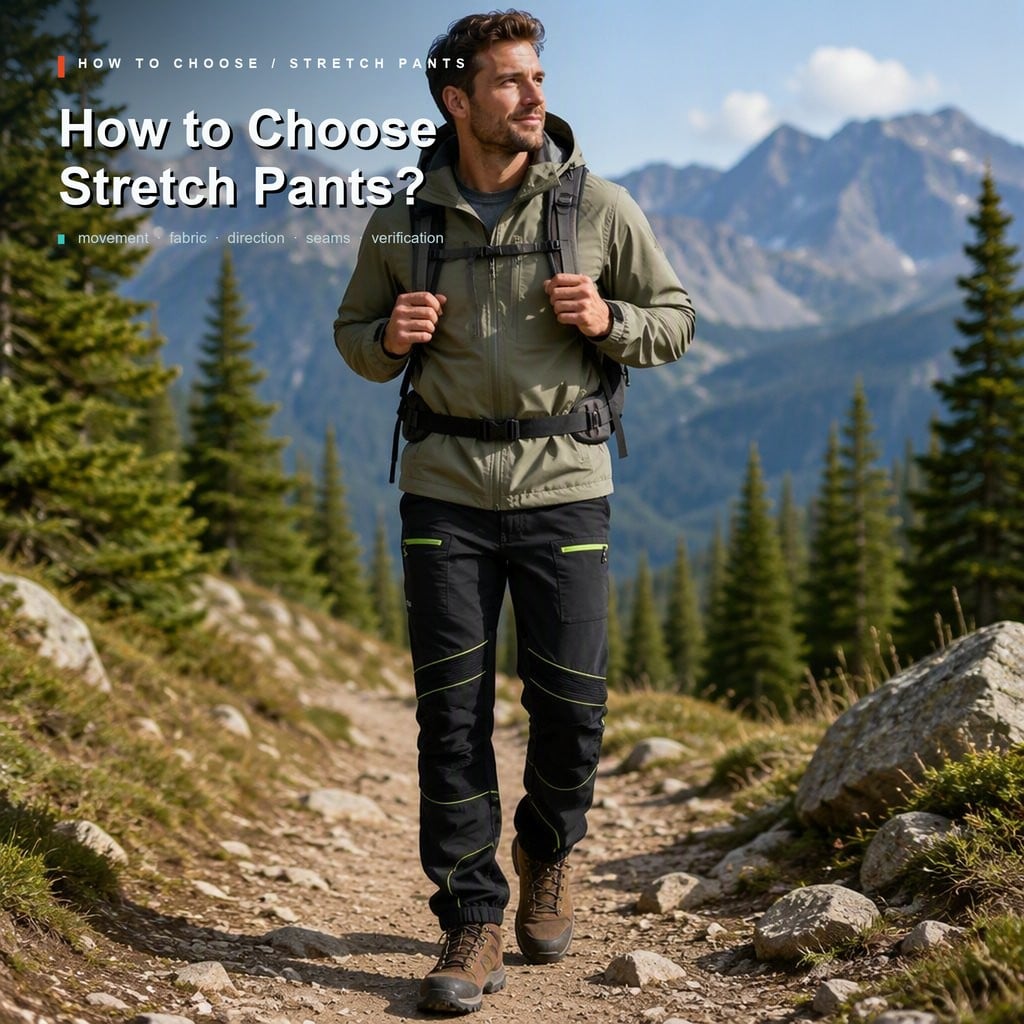
How to Choose Stretch Pants: Five Filters Before You Order
Choosing stretch pants goes wrong in a predictable way. Buyers compare blends and GSM first, pick the softest swatch, then find out at week six that the knees bag out. The order of decisions is the problem. Work backwards from how stretch pants fail and the spec writes itself.
Five filters follow: movement, fabric, stretch direction, construction, verification. Each ends with a pass/fail question. If a supplier can't answer with a number or document, stop there.
1. Stretch Pants Start With Movement, Not Fabric
Write down what the wearer does before you open a fabric card. A picker kneels and reaches; a courier climbs in and out of a van. Each puts tension in a different place, and that decides which stretch pants spec holds up.
Ask three things. How deep is the squat? Does the leg twist? Does a tool belt pull the waistband? A shallow repetitive task needs recovery; a deep occasional twist needs elongation. Those are different buys, and one pair rarely optimises both.
Note the temperature too. A fabric that feels loose in a warm showroom can feel restrictive on a cold dock. If the stretch pants shift crosses seasons, say so in the brief.
2. Pick Stretch Pants Fabric for the Laundry
Two systems dominate stretch pants, and the laundry chooses more than the hand feel does.
Property |
Polyester / spandex |
Nylon / spandex |
Mechanical stretch |
Typical feel |
Soft, high elongation |
Smooth, premium hand |
Firmer, less give |
Recovery after hot wash |
Good if heat-set |
Good, depends on setting |
Best of the three |
Abrasion |
Good |
Better |
Good |
Best fit |
General work, uniforms |
Outdoor, wet conditions |
Industrial laundry, repeat bulk |
Main risk |
Elastane fatigue at high heat |
Cost, slower dry |
Lower peak stretch |
Elastane gives stretch pants a soft hand and high elongation cheaply. Under 60–75 °C washing with chlorine or peracetic acid, it ages faster than the base fibre. If your laundry runs hot, ask for recovery after the wash cycle, not at the mill.
Mechanical stretch uses textured yarns instead of an elastic core, giving up peak elongation but holding shape across hot cycles. For a bulk programme washed weekly, that elastane vs mechanical trade wins. Our WH732 trouser runs nylon / spandex at about 300 gsm with roughly 15% elastane; the WH731 jacket uses polyester / spandex at about 260 gsm. Those are starting points — ask for a swatch at your own GSM.
Check the composition report and GSM on a cut swatch. A supplier quoting "stretch fabric" for stretch work pants with no percentage or weight is selling a hand feel. Verify material certifications through the OEKO-TEX label check, but a fabric certificate is not a garment test.
3. Choose Stretch Pants by Direction of Stress
Four-way stretch sounds better and often isn't. Two-way runs across the weft — bending a knee, reaching forward. Four-way adds warp stretch for twisting and cross-legged movement.
Map direction to task. Picking, driving and bench work are two-way loads. Kneeling on uneven ground and climbing put diagonal stress across the leg — that's where four-way earns its premium. For stretch pants on a desk-to-van route, four-way adds cost without changing performance.
High-stretch panels hide a trade: reflective tape and cargo pockets need a stable base. Tape on a stretch zone lifts after washing; a deep pocket on a high-recovery panel distorts. Ask which panels are stabilised before approving the placement drawing.
4. Spec the Construction That Fails First
Elastane rarely fails first. The seam does. When stretch pants come back from a wash test with a blown crotch seam or a twisted leg, the fabric is usually fine and the stitch is wrong.
Ask for four things in the seam construction spec:
- Seam type and thread. A flatlock or overlock with stretch-compatible thread moves with the panel. A locked straight stitch in rigid polyester cuts stretch at the seam.
- Seam elongation value. Stitch stretch should be reported alongside fabric stretch. A 30% fabric with a 10% seam is a 10% garment.
- Knee and crotch construction. A gusset and an articulated knee reduce the load on a single seam. Bar-tack the pocket corners that carry tools.
- Waistband build. A stretch waistband absorbs about one and a half size steps, so a seven-size range covers the fit of ten. Hold 2–4 cm negative ease so stretch pants recover rather than stay stretched.
For the reasoning behind elongation versus recovery, see our stretch recovery guide. It covers test methods; this section covers what to write on the order.
5. Verify Stretch Pants Before Bulk, in Your Wash Cycle
The last filter removes bad suppliers. Ask for growth and recovery with the wash count stated — for woven stretch pants, ASTM D3107 covers stretch and growth from woven stretch yarns. ASTM D2594 covers low-power knit stretch and is the wrong method for a woven trouser; a supplier citing it hasn't read the scope.
Set the sequence in writing: lab dip under D65 light, a full size set sewn, the agreed wash procedure at your real temperature and chemistry, then measure. Re-check dimensional change, colourfastness and seams after the cycle — not as-new. Wear-test stretch pants with the team for a full shift; a pair that passes a lab test can still ride up at hour ten.
EN ISO 13688:2013+A1:2021 covers sizing and marking, not stretch performance. For high-visibility stretch pants, the tape and the smallest certified size must meet EN ISO 20471 after laundering; reflective piping on a navy panel is a low-light detail, not certification. Ask which standard fits your risk assessment, not just "compliant".
Our work trousers range covers the non-stretch option if verification fails — some roles don't need the premium. Our certificate page separates fabric documents from garment reports, the distinction that matters here.
Six Questions About Stretch Pants for Every Supplier
- What is the fibre composition and the measured GSM on a cut swatch?
- What is growth and recovery after your wash cycle, with the test method named?
- Is the stretch elastane-based or mechanical, and how is the fabric heat-set?
- Which panels are stabilised for tape and pocket placement?
- What seam type and thread are specified at the crotch and knee?
- Can they provide a size set for a shift-length wear test before bulk?
A supplier answering all six about stretch pants with documents makes the shortlist. One answering with adjectives does not.
FAQ
Are stretch pants better than regular work trousers? Not by default. They pay off where movement restricts the job — kneeling, climbing — or where one size range must cover more bodies. For static bench work, a plain woven trouser costs less.
What GSM should stretch pants be? No single number. Around 260 gsm suits a warm-climate layer; about 300 gsm suits outdoor and heavier work. Ask for measured weight on a swatch and match it to the season.
Is four-way stretch worth more for stretch pants? Only where movement is diagonal. Kneeling on uneven ground and crouching use it. Walking and driving load the weft, where two-way performs the same job for less.
How long does elastane last in stretch pants under industrial laundry? It depends on temperature, sanitiser and cycle count, not a fixed month figure. Ask for recovery after your laundry's real cycle count, and compare it with mechanical stretch at the same count.
Can stretch pants be certified for high visibility? Yes, when the tape is on a stabilised panel and the smallest size still meets the minimum retroreflective area after washing. Check the class on the certified garment, not on the fabric.
About the author. Wuhan Kinglong Protective Products (Hubei) Co., Ltd. product team. Over 20 years in workwear and outdoor garments, three million pieces a year under ISO 9001, OEKO-TEX Standard 100 on materials, SGS / ICS audits from European partners.
Table of Contents
- How to Choose Stretch Pants: Five Filters Before You Order
- 1. Stretch Pants Start With Movement, Not Fabric
- 2. Pick Stretch Pants Fabric for the Laundry
- 3. Choose Stretch Pants by Direction of Stress
- 4. Spec the Construction That Fails First
- 5. Verify Stretch Pants Before Bulk, in Your Wash Cycle
- Six Questions About Stretch Pants for Every Supplier
- FAQ