 EN
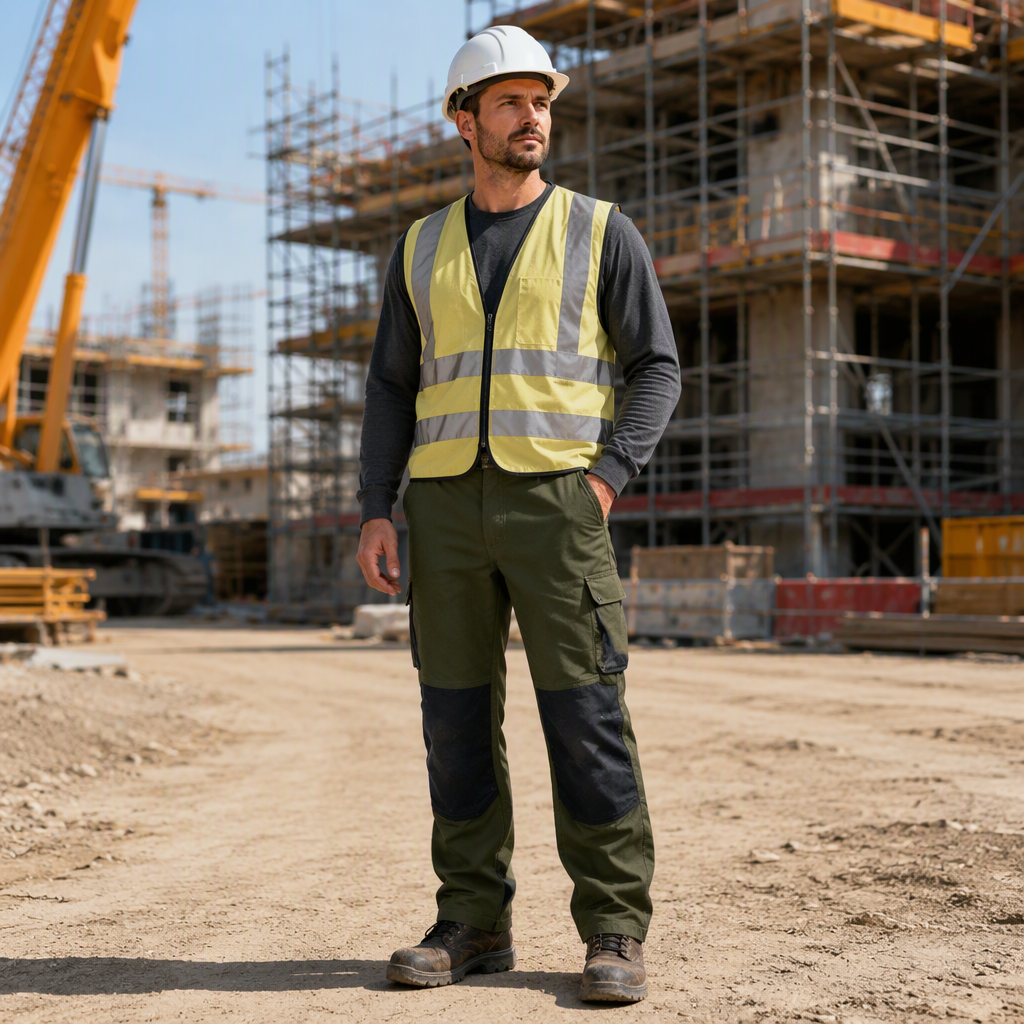
Choose work bibpants when the crew needs tool-carrying coverage over the torso, knee protection under a jacket, or a garment that stays put on a ladder. Choose work trousers when the job is warm, the crew layers their own jacket, or the task requires stripping off outer layers quickly. The decision comes down to three factors: tool load, climate, and how often the worker removes outer layers on site.
This guide is for distributors, brand owners and safety procurement teams sourcing workwear for construction, industrial maintenance, logistics and field service programs in North America and Europe.
What work bibpants actually are
Work bibpants (also called bib overalls, bib and brace, or salopettes in European markets) combine trousers with a shoulder-strap bib that covers the lower chest. The bib typically carries a front pocket, and the trousers carry thigh cargo pockets, hammer loops, and knee-pad pockets. Unlike coveralls, work bibpants leave the arms free, so the wearer can wear any jacket underneath or over them.
That design matters for trades where the jacket comes off in the afternoon but the torso still needs coverage. Work bibpants stay on, stay zipped, and keep tools against the body instead of sliding into a jacket pocket.
Bibpants vs trousers: side by side
Factor |
Work bibpants |
Work trousers |
Torso coverage |
Covers lower chest; worn over a shirt or jacket |
No torso coverage |
Tool carry |
Bib pocket + thigh cargo + hammer loop |
Thigh cargo only |
Layering |
Worn over or under any jacket |
Standalone, worn with a separate top |
On-and-off |
Full removal requires shoulder straps; slower |
Quick step in/out |
Warmth |
More insulation on torso |
Cooler in warm seasons |
Ladder / climb |
Stays put; no gap at the waist |
Can slide down or gap when reaching |
Best trades |
Construction, welding, cold-weather outdoor, mechanics |
Warehouse, delivery, indoor maintenance, warm-climate work |
The right answer is rarely one for the whole company. Many programs specify work bibpants for the outdoor and winter crews, and work trousers for the indoor and summer crews.
When work bibpants win
Work bibpants make sense when at least one of these is true on your site:
- Tool belt load is heavy. The bib pocket carries a phone, knife, notebook or radio, and the thigh pockets take the rest. Workers on ladders spend less time re-strapping a belt.
- The crew climbs, kneels or bends repeatedly. A bib does not gap at the waist when the wearer reaches up a ladder frame. Trousers slide down and expose the lower back.
- Cold or variable weather. The bib adds an insulating layer over the shirt without requiring a heavy jacket. When the sun comes out, the jacket comes off but the bib stays.
- Knee pad protection is required. Most work bibpants carry knee-pad pockets built in, and the bib design keeps the pad from riding down the leg.
- The site has a layering rule. Welding, electrical and outdoor crews often layer shirts, fleeces and jackets. Work bibpants work with any layering system because they do not zip at the front.
When work trousers win
Reach for work trousers instead when:
- Indoor or warm-weather work. A bib adds torso heat that nobody wants in a warehouse in July.
- The crew strips outer layers often. Paramedics, delivery drivers and site supervisors who go in and out of vehicles need fast on-and-off.
- The uniform already includes a waist-length jacket. Adding a bib under a waist-length jacket creates bulk and bunching.
- The program is a rental laundry. Bibpants have more seams, more straps and more adjustment points, which means more wear points in an industrial wash cycle.
- The worker's tool load is light. If the only carry is a phone and a tape measure, a cargo trouser is enough.
Fabric choices for work bibpants
Work bibpants take the same fabric choices as work trousers, with one extra consideration: the fabric has to hold up to shoulder-strap tension and repeated bending at the waist.
- Poly-cotton twill (65/35). The default for general construction and industrial use. Wrinkle-resistant, durable, easy to launder.
- Cotton canvas (12 oz class). Heavier, more rigid, breaks in over time. Classic for outdoor construction and farm use.
- Ripstop poly-cotton. Better tear resistance for abrasive sites; lighter than canvas.
- Stretch blend (elastane added). Better for electricians, HVAC and installation crews who kneel and reach. We covered this in our stretch work jacket guide, and the same four-way stretch logic applies to stretch bibpants.
- Waterproof / breathable (3-layer). For winter and rain programs; usually bonded rather than woven.
Construction details buyers should check
When you evaluate work bibpants samples, look past the pocket layout first:
- Strap hardware. Metal buckles last longer than plastic on a daily on-and-off garment. Adjustable straps should not slip once set.
- Knee-pad pockets. Pre-shaped or open-back? Pre-shaped holds the pad in place; open-back lets the wearer slide a pad in without removing the pants.
- Stress points. Bar-tacks at the bib pocket corners, the shoulder strap junctions, and the hammer loop. These are the first places to tear.
- Closure at the waist. Some work bibpants zip at the side, some button, some pull on. Side zippers let the worker use the bathroom without removing the whole bib.
- Reinforcement at the back of the knee and the seat. These are abrasion zones on every tradesman.
About KINGLONG (NEO SAFETY® / BIZLINK®): an SGS and ICS certified workwear manufacturer producing work bibpants, work trousers, jackets, vests and coveralls for distributors and private-label brands. We support OEM/ODM with custom fabrics, colors, embroidery and size-range programs. Contact our team for swatches and sample lead times.