 EN
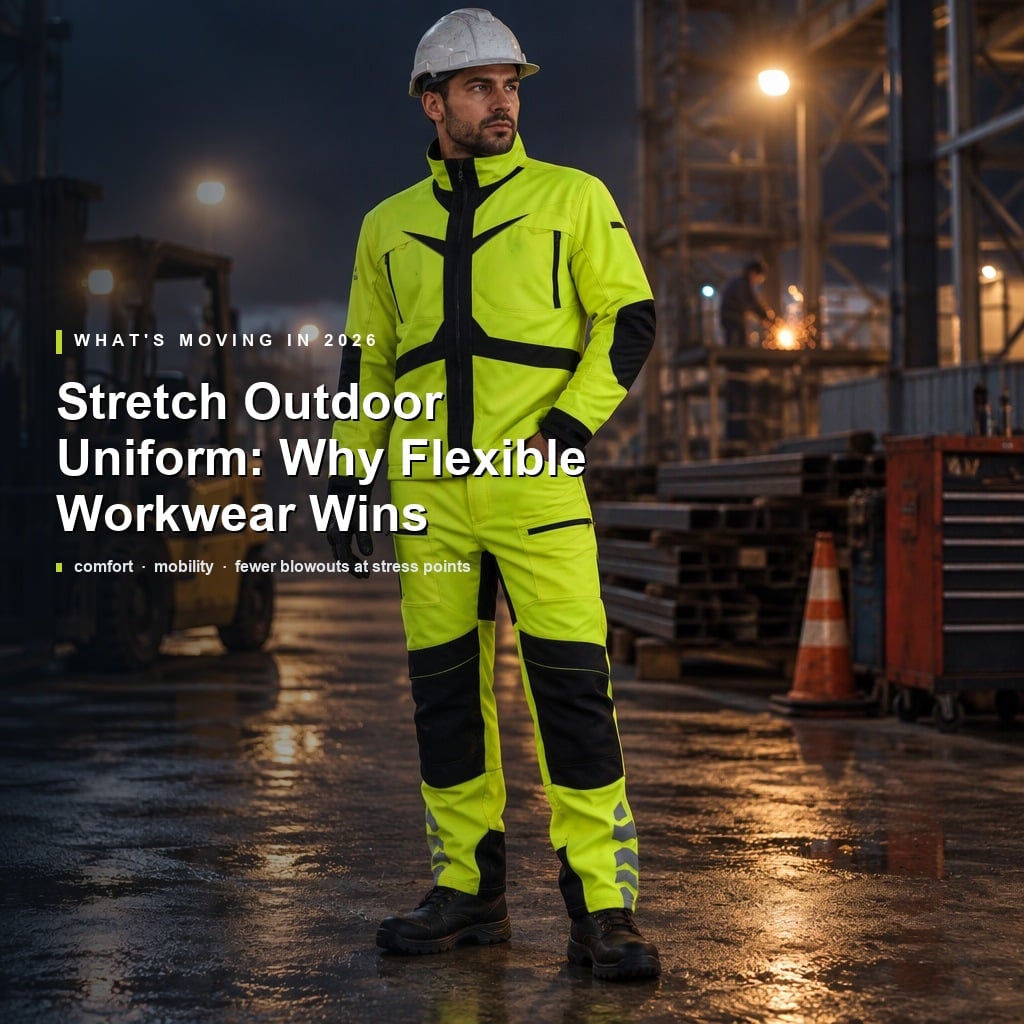
Rigid workwear has one failure mode that never shows up in a spec sheet: it fits you standing still. The moment a crew member steps over a barrier, kneels at a valve or reaches above a shoulder, the fabric either gives or the seam does the giving for it.
That is the argument for a stretch outdoor uniform, and it is not a comfort claim. Range of movement is measurable — seam elongation, recovery, the load a stitch line carries at full extension — and it changes what a garment costs over three seasons.
Why Stretch Became the Default in Outdoor Uniformes
Three things pushed it from a niche riding fabric into mainstream site wear.
The work changed. Utilities, grounds maintenance, rail depots and ground handling all involve climbing in and out of vehicles, kneeling and reaching across a body. A rigid twill fights those movements at the hip and knee, so crews take the outer layer off — the failure that costs you the audit.
Thin beat thick. Tela moderna pro uniformia extra muros cum extensione attingit figuras abrasionis usabilis ad 220–260 gsm pro bracis, ubi decennio ante opus erat tela canabacea plus quam 300 gsm pro eadem vita.
Hoc solvit problemum de stoccis. Tela bene graduata cum extensione amplectitur latiorem ambitum corporis per unam magnitudinem, itaque distributor minus SKUs portat. Hoc magis refert quam commoditas, cum ad stoccos committis.
Electio Tela: Polyester/Spandex vs Nylon/Spandex
Extensionem duobus modis advenire licet. Aut filum est elasticum — elastanum, quod in America Septentrionali spandex appellatur — mixtum ad 8–15% — aut textura mechanica extensionem praebet sine filo elastico. Filum elasticum melius restituitur et latiorem aptitudinem tolerat; textura mechanica dimensiones suas retinet ad altam temperaturam et non deterioratur per chlorem.
Practicalis divisio pro programma climatis mixti est mixta: textus ex polyestere et spandex ubi retentio formae et arida cito sunt momenti, textus ex nylon et spandex ubi textus attritionem patitur. Textus ex polyestere et spandex etiam tenet tonos fluorescentes melius, quod valet die quo aliquis postulat viridem limonem.
Property |
Polyester\/Spandex |
Nylon\/Spandex |
Resistentia ad abrasionem |
Bonus |
Melior — norma pro bracis et panelibus genicularibus |
Manu sentire |
Aridior, paulo crisper |
Mollisior, frigidior in cute |
Velocitatem siccitatis |
Celerius |
Pauco tardior |
Retentio coloris |
Excellentis, etiam toni fluorescentes |
Bona; requirit strictum controllem lotus tinturae in cinereis pallidis |
Sumptus |
Inferior |
Superior |
Usus rationabilis |
Tunica laboris extensilis, panella manicarum |
Braca laboris extensilis, refortificatio genicularis, sedes |
Using nylon exclusively raises the unit cost for a benefit the jacket does not require. Using polyester exclusively shortens trouser lifespan precisely where wear occurs — at the knee, seat, and hem. Combining both fabrics within one stretch outdoor uniform is the economical engineering choice, not a compromise.
The Sewing Room and the Size Range
Most complaints about stretch outdoor uniforms stem from the stitch line, not the fabric.
Tension, not stitch type, is typically the cause. Woven stretch fabric is sewn on a flat-bed machine at approximately 3 to 3.5 stitches per centimetre, with low thread tension and overlock finishing at the raw edges. Knitted stretch fabric passes through a four-thread flatlock machine. Setting the tension for a rigid fabric causes seam rippling after the first wash — puckering is the leading reason for returns in this category, and it results from incorrect machine settings.
Tape is a separate component. Retroreflective tape applied to a four-way stretch garment must be of stretch grade. Standard tape cracks at flex points and loses retroreflective performance long before the garment appears worn.
Heat transfer is where logos fail. Standard high-temperature film kills local elasticity; two washes later the print edge lifts. Specify low-temperature elastic film and log the pressing temperature on the tech pack.
A four-way stretch outdoor uniform lets one grade cover more bodies, but it does not remove the need for a grade. Sleeve and leg length still run in steps, and a jacket and trouser built on the same grading let a buyer order one ratio for the set — the actual commercial win, not the elastane percentage.
Breathability, DWR and the Trade-off Nobody Mentions
Breathability in a knit comes from structure: air moves through the fabric, so moisture leaves without a membrane. That is why a knit stretch outdoor uniform outperforms a coated shell in heat and underperforms it in sustained rain.
The trade-off in a stretch outdoor uniform lies in the finish. A durable water repellent keeps rain off the surface, and softeners, some elastane lubricants, and incorrect wash chemistry all strip it away. Two rules follow: test DWR after laundering—not on the sample—and never quote a waterproof rating based solely on a DWR finish. Water-repellent and waterproof to EN 343 are distinct claims, and a buyer who discovers the difference during the first storm will not reorder.
Hi-Vis Colour Is Not a Certificate
Fluorescent lime is a colour. It is not a class, and it is not a compliance story.
EN ISO 20471 assigns classes according to measured areas of fluorescent background, retroreflective material, and contrast material on the finished garment, plus chromaticity limits per dye lot. A stretch outdoor uniform complicates three of these: fabric relaxes and recovers, so areas are measured as worn; the tape must be a stretch grade; and elongation must be verified—not assumed. Under Regulatio (UE) 2016/425 , una pretesa di alta visibilità richiede anche una dichiarazione di conformità che nomini l’organismo notificato.
Tratta la certificazione come un progetto con costo e tempo di consegna. Un fornitore che risponde «sì, alta visibilità» in una sola riga o l’ha già testato o sta indovinando. Chiedi quale delle due opzioni.
Regole per la cura che mantengono l’elastane in vita
L’elastane muore per calore e agenti chimici, non per usura. Temperatura massima 40 °C, niente ammorbidente — riveste la fibra e compromette sia la capacità di traspirazione sia il trattamento idrorepellente (DWR). Niente candeggina al cloro. Niente asciugatura in asciugatrice a temperatura elevata: è il calore a distruggere l’elasticità di recupero. Ripristina il trattamento DWR dopo circa 20–25 lavaggi industriali.
Un’uniforme outdoor elastica che si allenta sul ginocchio dopo una stagione è stata quasi sempre lavata e asciugata ad alta temperatura. Si tratta di un problema legato alle istruzioni per il lavaggio, e va inserito nel contratto, non discusso solo dopo la prima lamentela.
Notae de Approvisionamento
Ask any outdoor uniform supplier three questions before comparing price: elastane percentage and stretch direction, wash-test data at your customers' laundry regime, and whether tape and transfer film are stretch grades. Those answers separate a factory from a trader with a catalogue.
Wuhan Kinglong Protective Products has made workwear for over twenty years, runs three million pieces a year under ISO 9001 and holds OEKO-TEX Standard 100 on its material supply. Stretch programmes are cut and sewn in-house, so the tension settings that decide seam behaviour stay under our control. The stretch outdoor uniform range covers the WH731 stretch work jacket and WH732 stretch work pants; the hi-vis range is where certified visibility programmes sit, plain work Trousers cover the rigid end, and our certificationes are listed with scope rather than logos alone.
Send a crew size ratio and site conditions; you get fabric options, a grade set and a price. Every supplier says that. We do it in two working days.
Quaestiones Frequenter Rogatae
Quid est vestis exterior extensibilis saepe facta ex?
Tela knit ex polyestere/spandex aut nylon/spandex cum 8–15% elastane, aut tela texta mechanice extensibilis sine filo elastico. Singulae partes vestis exterioris extensibilis seliguntur pro loco ubi usus maxime incidit — nylon/spandex in genibus, polyestere/spandex in tunicula.
Num tela extensibilis cito deterescit praeter vestem rigidiorem operis?
Non ad aequalem pondus, sed vestis exterior extensibilis deficiens aliter se habet. Extensio abraditur in genibus et sedili potius quam in suture, quare partes renfortatae magis valent hic quam in bracis de canapo. Sub circa 220 gsm, vitae brevioris expectatio est.
Num vestis exterior extensibilis certificari potest secundum EN ISO 20471?
Ita, post experimenta — non per declarationem tantum. Vestis finita requirit areas fluorescentes et retroreflectivas, experimentum chromaticitatis pro singulis lotis colorantis, fasciculum extensibilem gradus verificatum pro elongatione, et declarationem conformitatis. Hoc separatim computandum est.
Quot lavationes antequam extensio amittitur?
A quattuor-via extensibilis textilis suum recuperationem bene tenet ultra 50 lavationes domesticas ad 40°C. Quod primum deficit est DWR, circa 20–25 cycli industrialis, et fascia si non est gradus extensibilis. Temperatura lavationis est maxima singularis variabilis.
Quod MOQ applicatur ad uniformem exterius extensibilem ad mensuram?
Omnis fornitor uniformium exteriorum aliter citat: colores in stock incipiunt infra quam lota colorum ad mensuram, et tempus ducens progreditur ex approbatione exemplaris. Mitte proportionem magnitudinum et quantitatem destinatam ad numerum firmum potius quam ad intervallum.
Index Rerum
- Why Stretch Became the Default in Outdoor Uniformes
- Electio Tela: Polyester/Spandex vs Nylon/Spandex
- The Sewing Room and the Size Range
- Breathability, DWR and the Trade-off Nobody Mentions
- Hi-Vis Colour Is Not a Certificate
- Regole per la cura che mantengono l’elastane in vita
- Notae de Approvisionamento
- Quaestiones Frequenter Rogatae