 EN
EN

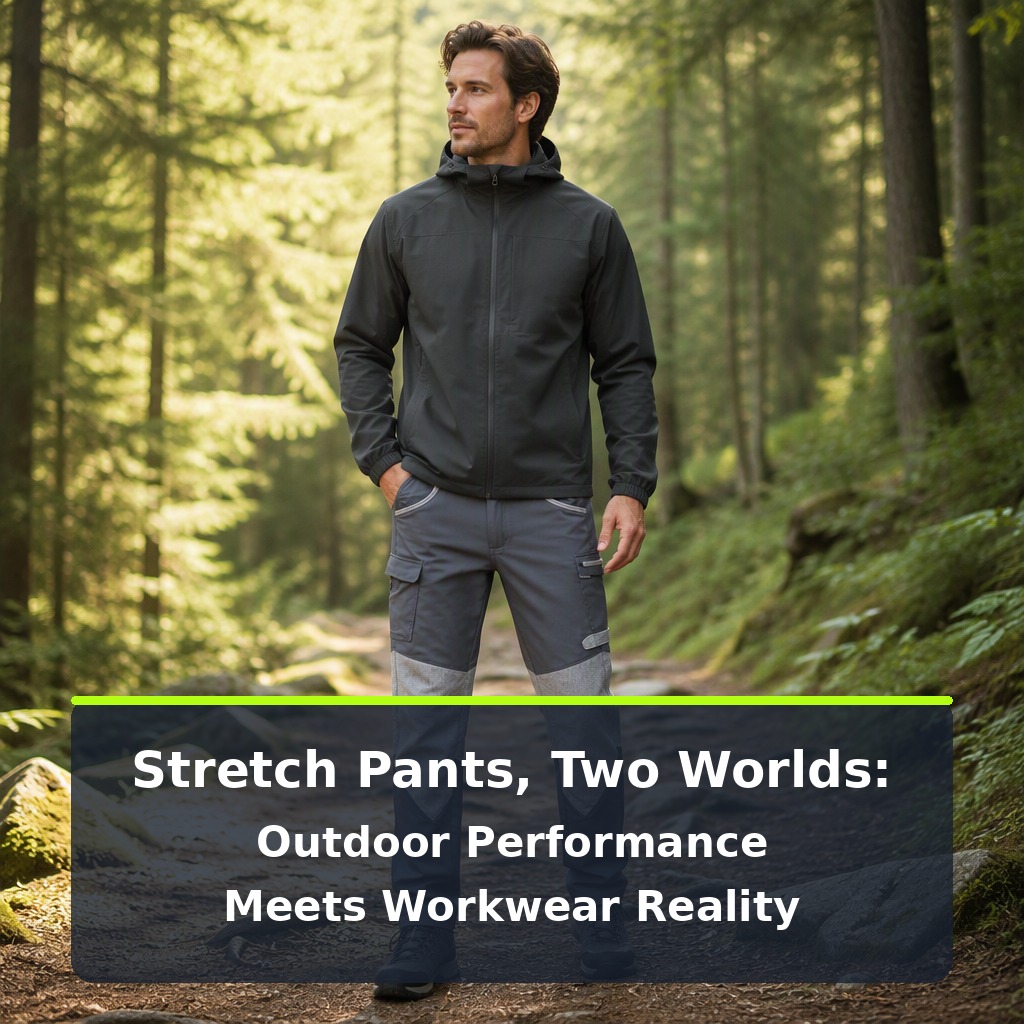
There is a category of clothing that lives a double life. On Saturday it is on a ridgeline trail six hours from the road; on Monday the same design is kneeling on a workshop floor under a truck. Stretch pants crossed from outdoor gear into workwear a decade ago, and the migration never stopped — because the two worlds, for all their differences, want the same thing from the fabric: movement without wear-out. This guide looks at how one stretch pants platform serves both the outdoor theme and the workwear theme, and what that crossover means for buyers who outfit either one — or both — with stretch pants.
For outdoor.
Everything that makes stretch pants work on a mountain comes from trail technology — the outdoor theme wrote the original spec for stretch pants. The four-way elastane construction was engineered for climbers who needed full hip extension on high steps without sagging fabric underneath a harness. The lightweight builds came from thru-hikers counting grams. The ripstop grids arrived because brush and granite destroy plain weaves far from any replacement. Water-repellent finishes were tuned for weather that changes hourly. That is the outdoor inheritance in every pair of trail-tested stretch pants: decades of mountain R&D, folded into cloth.
The workwear adoption
Workwear adopted stretch pants for a harder-to-fake reason: economics. A mechanic or installer moves the way a hiker moves — squats, ladder steps, kneeling, repeated pocket-loading — but does it forty-plus hours a week, fifty weeks a year. Rigid work pants die at the knees and crotch seams from motion alone, long before the fabric wears out. Stretch construction absorbs that motion instead of fighting it, and the garment lifespan math flipped: stretch work pants began outlasting rigid ones precisely because they move. Add a heavier base cloth and reinforced stress points, and the outdoor platform became a stretch pants option for uniforms.
Where the outdoor theme sets the standard
For buyers outfitting outdoor programs, the stretch pants benchmark stays trail-shaped. Weight leads: breathable lightweight fabric that dumps heat on climbs, because exertion is the constant. Weather handling follows — a finish that beads drizzle and wet brush without sealing the fabric, since a waterproof shell on working legs creates its own rain from inside. Details finish the outdoor spec for stretch pants: an elastic waist that sits comfortably under a pack belt, a leg cut that clears boots, pockets that shut against scramble-induced spills. Colors run earth tones for hunters and anglers, brights for visibility where the trail crosses traffic.
Where the workwear theme sets the standard
The workwear benchmark for stretch pants inverts the priorities. Durability leads: a denser stretch base, double-stitched seams, and reinforcement at the knee and seat — the two zones where a working week concentrates its abuse. Storage follows, and it is serious: tool pockets sized for the actual tools, closures that survive being sat on, layouts a mechanic can navigate without looking. Clean presentation matters in ways outdoor gear never worries about — customer-facing crews need stretch pants that read as trousers, not trail wear, so the cut stays straight and the branding stays quiet. Certification matters most here: OEKO-TEX Standard 100 materials, the credential uniform tenders and safety programs ask for by name.
The crossover advantage
The interesting buyers are the ones who need both worlds at once from their stretch pants. Rental outfitters outfitting guides who work the river on weekends and the warehouse on weekdays. Maintenance crews at resorts and parks whose job is outdoors but whose dress code is corporate. Security and events teams standing outside in all weather, moving constantly, needing visibility options on a stretch pants platform. For these programs the crossover is not a compromise — it is the product: outdoor-grade movement and weather handling, workwear-grade durability and presentation, in one SKU of stretch pants ordered from one factory.
Even single-world buyers benefit from the double lineage. The outdoor buyer gets stretch pants that survive brush because workwear demanded tougher cloth; the workwear buyer gets stretch pants that breathe through an August shift because hikers refused to sweat. Each theme dragged the other forward.
What to demand from either theme ?
Three fundamentals apply to stretch pants across both worlds, and they are where cheap versions fail first. Four-way stretch, not two-way — one-axis stretch binds at the knee on the second squat. Real recovery — fabric that returns to shape after the thousandth bend, because bagged knees are a fit failure dressed as a wear one. Certified materials with the standard European buyers request by name. Then dial the theme-specific specs for your stretch pants: weight, weather finish and pocket layout for outdoor; base weight, reinforcement and presentation for workwear.
Stretch pants earned their double life honestly: outdoor technology built the movement, workwear economics proved the durability, and the crossover programs get both in one garment. Buy stretch pants by theme — light and weather-ready stretch pants for the trail, heavy and reinforced stretch pants for the job site — but never compromise on the three fundamentals underneath. One platform, two worlds, three non-negotiables.