 EN
EN
Every safety buyer knows the cycle: brand-new fluorescent orange pants look perfect on day one, and six weeks later they are washed-out, dirt-shadowed at the seat and knees, and frayed at the hem. The worker is still visible on paper; the garment has quietly stopped doing its job. Two-tone hi vis work pants exist to break that cycle. Instead of one color doing two jobs
The two-tone logic: seen where it matters, tough where it wears
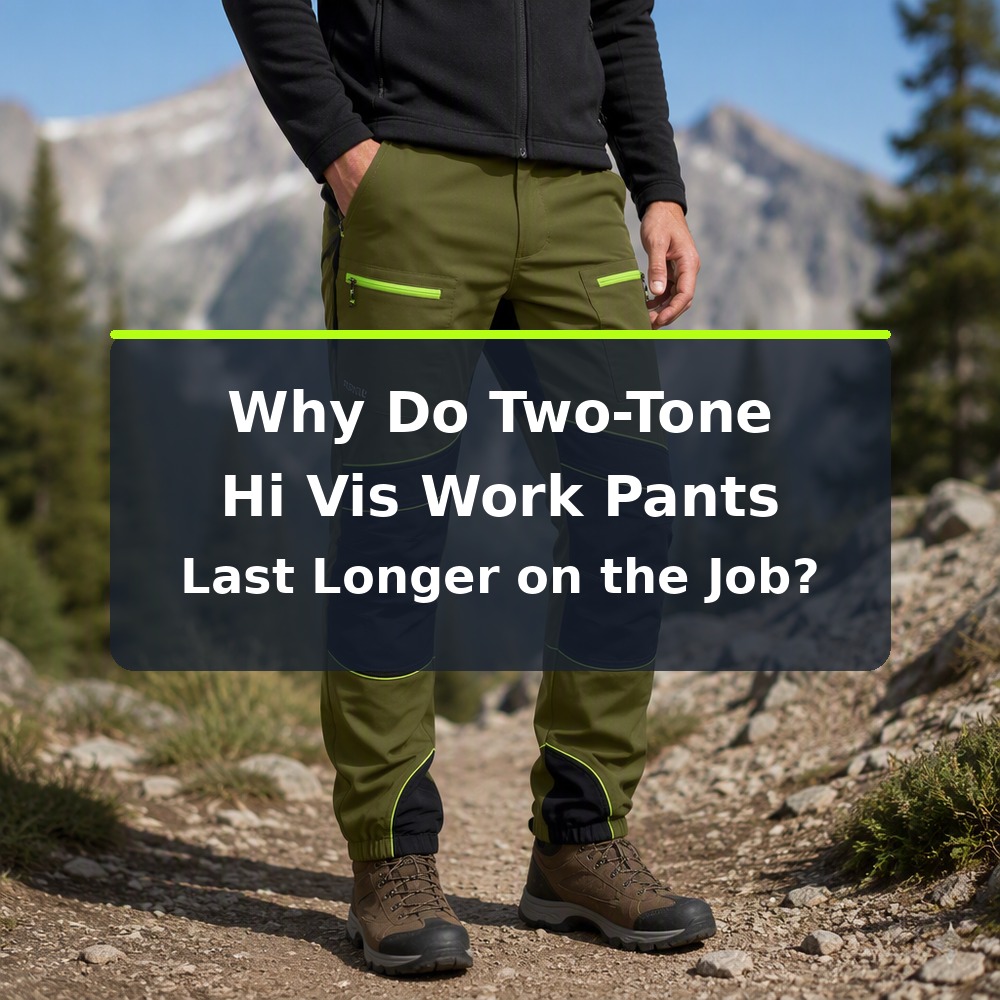
The idea behind two-tone hi vis work pants is simple: put the fluorescent color where the eye of a driver or supervisor looks, and put the dark, hard-working color where the job punishes the fabric. Fluorescent orange covers the thighs and calves — the zones that read at a distance. Navy panels take the seat, the knees and the hem — the zones that meet dirt, tools, ground contact and constant flexing.
The result is a pair of hi vis work pants that still looks like working equipment months in, not a faded costume. That matters more than vanity: garments that look spent get replaced early, and early replacement is where safety budgets leak. Two-tone pants stay in service longer, so the same safety spend covers more wear-time.
Day visibility: what fluorescent fabric actually does
By day, the fluorescent orange on hi vis work pants does something ordinary dye cannot. Fluorescent material converts part of the ultraviolet light in daylight into visible light — the surface actively glows a little brighter than its surroundings rather than just reflecting them. Against gravel, concrete, roadside dust or a dim warehouse, that difference is what makes the wearer pop.
This is also why condition matters. Fluorescent fabric that is caked in ground-in grime stops converting light efficiently — which is exactly the failure mode of single-color work pants, where the seat and knees go grey-brown within weeks. Two-tone design protects day-one brightness for the life of the garment.
Night visibility: double bands on the moving limbs
After dark, the job switches to the retroreflective bands. Double bands ring each leg of these hi vis work pants, and the placement is deliberate: legs are the parts of the body that move most, and the human eye reads motion before it reads shape. A walking figure in headlights becomes a set of live, bouncing light points — which the brain recognizes as a person, not a traffic cone or a sign.
Double banding matters for another reason: a single band can be blocked by a bent knee or a tool belt at the wrong angle. Two rings per leg mean that in almost any working posture, at least one reflective surface faces the light source. When choosing hi vis work pants, count the bands — it is the cheapest visibility upgrade on the garment.
Ask any workwear buyer what retires a pair of pants: rarely the main fabric, almost always the hem. Boots catch it, gravel abrades it, industrial washing hammers it, and once the hem starts fraying, the unraveling climbs. Reinforced hems on hi vis work pants push that failure point back by months of hard use.
This detail separates garments designed for real sites from garments designed for catalogs. On sample day, turn the cuff inside out and look at the hem construction: a reinforced hem is visibly denser and stiffer than a fashion hem — that difference is the garment's real service life.
Pockets that survive the work
Two-tone hi vis pants carry more than legs. Tools, tape, gloves, a phone, a radio — the multi-pocket layout keeps essentials on the body and reachable without a trip to the toolbox. Two things decide whether that layout works in the field: placement (pockets clear of the knee bend, reachable with either hand) and closure (zips or secure flaps that stay shut through bending, climbing and kneeling).
Hi vis work pants earn their place in a program twice over. Worn alone, they mark the lower body — the right call for road crews where legs are what drivers see first behind barriers. Worn with a matching hi-vis jacket or vest, they complete a full-body silhouette with no visibility gap at the waist.
For buyers running uniform programs, that flexibility means one pants SKU serves multiple roles and seasons, and a matching top can be added later without re-sourcing the bottoms.
Bands: two retroreflective rings per leg, positioned to stay visible in a working crouch. Two-tone: fluorescent zones on thighs and calves, dark panels on seat, knees and hem. Hem: turn the cuff inside out — reinforced, dense, stiff. Pockets: load them, squat, climb — nothing falls out. Fit: room to layer over base layers without binding at the thighs. Fabric: ask for composition and weight in writing, and the care instructions for keeping the reflective bands bright.
Custom hi vis work pants programs typically run 500 pieces minimum per style and color, with samples in about a week and bulk production in 30 to 45 days. Confirm every term in writing before any deposit, and test the sample the way it will actually be worn — on site, in motion, in weather.
The short version
Two-tone hi vis work pants last longer on the job because every fabric does the job it is best at: fluorescent orange on the zones a driver sees, navy on the zones the work punishes, double reflective bands on the moving legs for night, a reinforced hem where pants die first, and pockets that stay shut through real movement. One pair covers day and night, alone or layered — and stays presentable long after single-color pants have washed out. Check the six points above on sample day, and the next order of hi vis work pants will be the last one for a while.
Sourcing hi vis work pants for a team or a program? Send us your target quantity and color plan.