 EN

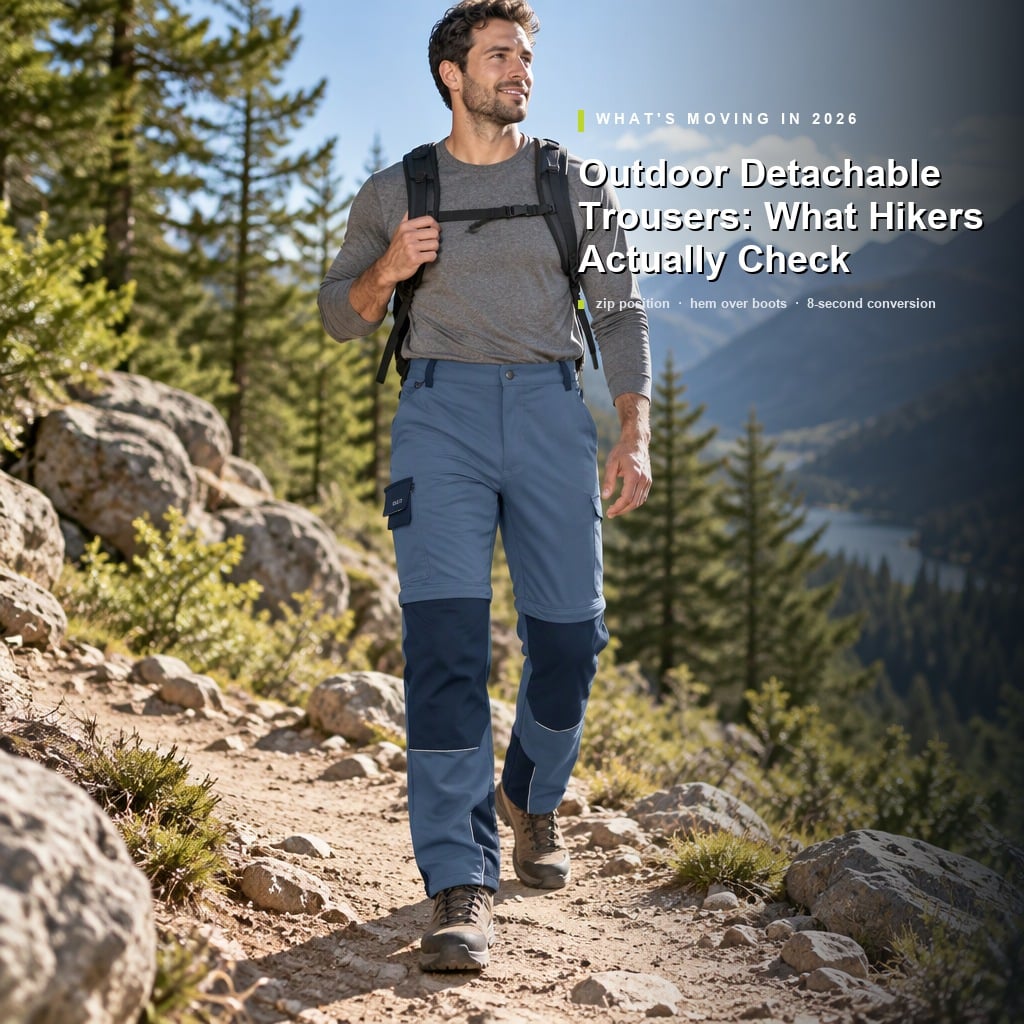
Nobody buys outdoor detachable trousers to save money. You buy them so one pair covers a cold trailhead and a hot ridge on the same walk. That promise holds — when the pair is built for walking, not for standing in a warehouse.
Fabric rarely decides it. The zip does, and where that zip sits, and what happens at the hem when you wear boots. All three are visible in a shop in under a minute.
Why One Pair Beats Two
A day on the hill swings 13 to 15°C between car park and summit, and wind takes another 5 off the felt temperature. Carry trousers and shorts and you carry one of them for nothing. Outdoor detachable trousers replace both, and convert in about eight seconds.
Eight is the number to hold onto. At thirty — tape catching, pull tucked inside the leg where a glove cannot find it — you will not convert. You will sweat uphill in long trousers and call it fine.
Hence the first test: glove on, hands wet, close the calf zip three times. A pair that fails in a warm shop fails on a ridge.
Where the Zip Sits Changes the Garment
Three positions, not interchangeable.
At or just above the knee, 2 to 5 cm up. Standard, for good reason. The shorts still cover seat and thigh, the zip clears the knee crease, and you kneel without pressing a slider into your patella.
Mid-thigh. Shorter shorts, more airflow, a stiff seam exactly where your palm rests and a harness loop crosses.
On the knee. Neat in the shop, worst on a trail. Every kneel flattens the slider.
Then the hip belt. Load your pack and watch where the belt lands against the seam — a belt crossing the zip of outdoor detachable trousers rubs a hot spot by the second hour. Nobody prints that in the copy.
The Hem Is the Spec Nobody Checks
This sends more outdoor detachable trousers back to the shop than any zip failure.
Once the lower leg comes off, the hem is fixed. Pull on a mid-cut boot — collar around 13 to 15 cm — and a narrow hem sits right on it. Walk uphill, the hem rides, the cuff rubs, grit gets in.
Two fixes are worth paying for: a hem wide enough to clear the boot, roughly a 20 to 23 cm flat half-circumference, or a short side split with a zip or popper so you can open it over the boot. The split is the cheaper of the two and solves more cases.
Check the finish. Raw or single-fold edges fray inside a season. You want a bound hem with a bartack at the split.
Fabric: Three Numbers, One Trade-off
Weight, stretch direction, and whether the nylon spandex fabric carries a DWR finish.
Spec |
Hiking pairs |
Site and field pairs |
On the hill |
Weight |
140–190 gsm |
220–280 gsm |
Above 200 gsm you feel it on every climb |
Stretch |
Two-way, weft |
Two- or four-way |
Four-way moves better, bags at the knee sooner |
Dry time |
About an hour in sun and wind |
Most of a day |
Wet legs at dusk are a safety issue |
DWR |
Standard, 20–25 washes |
Optional |
Re-proofing is maintenance, not a defect |
Light fabric dries fast and wears through at the knee. Heavy fabric survives scree and takes all day to dry. Walk in wet grass more than on rock and accept the shorter life.
DWR is a consumable. Around 20 to 25 washes and it is gone, which is normal. Outdoor detachable trousers that wet out after a wet season are not broken — the finish is due.
Pick by Trip, Not by Feature List
Feature lists flatter every pair. Trips are narrower, and so are the pairs that suit them.
Your usual trip |
Zip position |
Weight |
The detail that decides it |
Summer day hikes |
Above knee |
140–170 gsm |
Hem wide enough to clear a boot collar |
Multi-day trekking |
At the knee |
170–200 gsm |
Crotch gusset; zip clear of the hip belt |
Fishing and wet wading |
Above knee |
150–180 gsm |
Quick dry; do not rely on the DWR |
One-bag travel |
At or above knee |
150–190 gsm |
A hem that still looks tidy in a town |
Field and site work |
At the knee |
220–280 gsm |
Knee abrasion; bartacked tape ends |
If you only walk in dry summer, plain shorts do the job better and cheaper. If you walk in winter, no unlined pair of outdoor detachable trousers is warm — these are shells.
What Actually Breaks, and Why
Everything above is a shop test. What follows comes from the cutting floor, and it is rarely the zip brand people blame.
Twisting legs come from differential shrinkage: tape and shell shrink at different rates. Wash a pair of outdoor detachable trousers ten times with tape pulling tighter than the shell and the leg spirals; by twenty you see it across a car park. The other cause is tension — sew the circle with the fabric stretched and the zip carries load from day one. Fine in the sample room, binding the first time you kneel on wet ground.
Both faults are cheap to prevent and invisible in a photograph. That is why a sample you cannot wash is not a sample.
Care keeps the rest alive. Close the zips, wash at 40°C, no softener, no dryer — heat kills elastane and distorts tape faster than any trail. Bag the detached sections; a shorts leg on its own is scrap.
When Outdoor Detachable Trousers Are the Wrong Buy
Welding, hot-metal handling, chemical splash: no. The zip adds a seam and a gap that no fabric fixes, and no pair of outdoor detachable trousers belongs in that environment.
Certified high visibility is conditional. Retroreflective tape on a stretch seam has to be a stretch grade, and elongation tested before anyone claims EN ISO 20471. Fluorescent fabric alone is not a certification under Regulation (EU) 2016/425 — the finished garment needs the required areas, a chromaticity test on the dye lot, and a declaration of conformity. If the risk assessment needs certified hi-vis, buy a certified garment and keep the convertible work pants for everything else.
Hard on knees — scrambling, caving, a lot of kneeling — a fixed pair of stretch work trousers with a reinforced knee outlasts any detachable design.
FAQ
Do the detached legs get lost? Constantly. It is the most common complaint about outdoor detachable trousers, on trails and in rental programmes alike. Bag the sections with the garment and plan for a small annual loss.
Can a broken zip be replaced? On detachable work pants, usually yes at garment level, if tape and slider match. Get the zip spec from the brand so a replacement exists in three years.
Are they warm enough for autumn? Not alone. Unlined convertible pants are shells. Around 8°C while moving is fine with a base layer; standing still you want more — a lined pair, or a softshell jacket over the top.
How do I re-proof the DWR? Clean first, since detergent residue stops the finish bonding, then spray or wash-in and tumble low if the label allows. Every 20 to 25 washes.
About the author. Written by the product team at Wuhan Kinglong Protective Products (Hubei) Co., Ltd. We have manufactured workwear and outdoor garments in Hubei for over 20 years, run three million pieces a year under ISO 9001, and hold OEKO-TEX Standard 100 on our material supply. Our stretch outdoor uniform and outdoor ranges are audited by European partners through SGS and ICS.