 EN
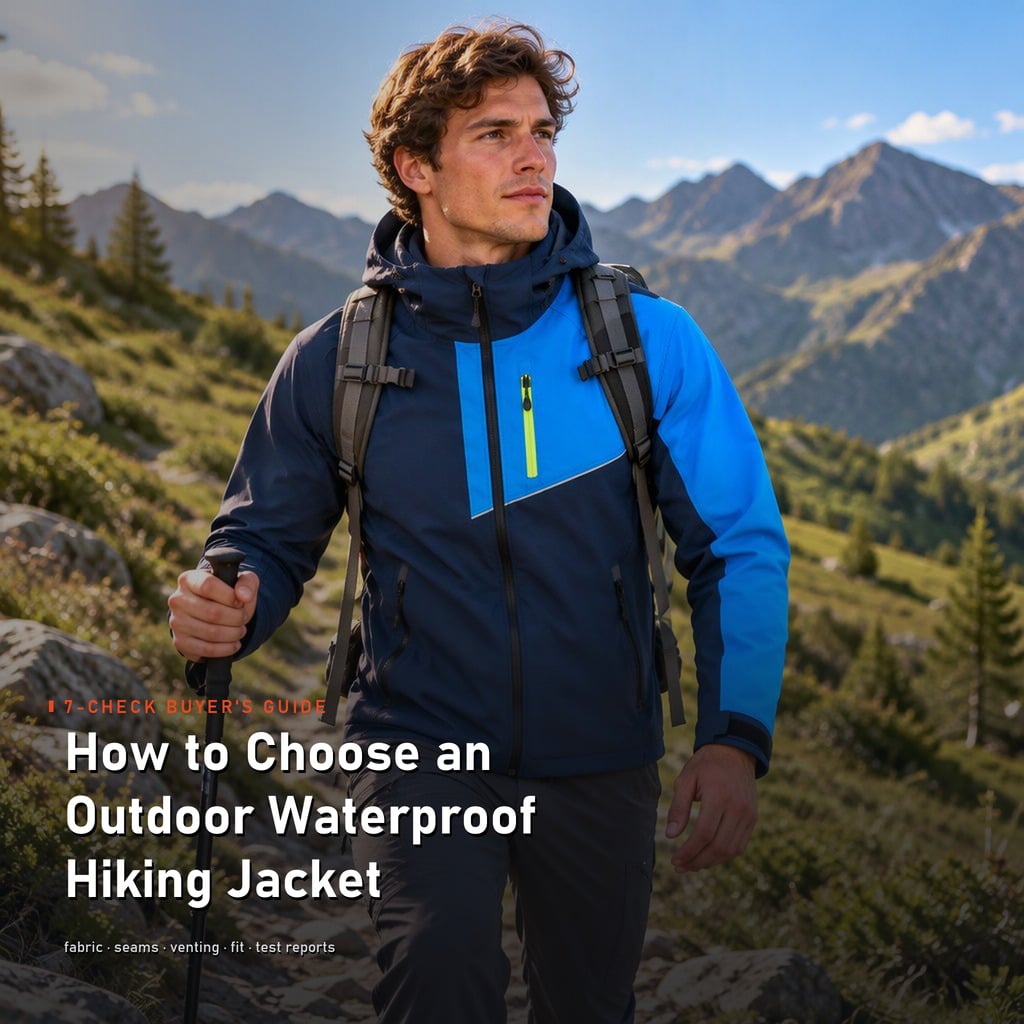
Most buyers start with the water-column number. Wrong first question. An outdoor waterproof hiking jacket is fabric, seams, vents, hood and fit — the right one depends on the trip, not the biggest figure on a hangtag.
Here's the order we use when a brand asks us to develop one: seven checks and one wear test with a loaded pack. An outdoor waterproof hiking jacket that passes all seven rarely comes back as a "leaking shell" complaint.
1. Define the Trip Before the Spec
Write down where it'll be worn before you write a number: rain duration, output, stops, pack weight, temperature.
A one-hour shower and a six-hour wet trek with 12 kg are different products. The first needs a packable shell; the second, an outdoor waterproof hiking jacket with sealed construction, a closing hood and vents you can open while moving. Long stops need a mid-layer — a shell makes no heat.
Trip profile |
Specify |
Skip |
Day hike, passing showers |
Packable 2.5-layer shell |
A heavy 3-layer carried all day |
Multi-day trek, changeable weather |
Vented shell plus light mid-layer |
A softshell as the only outer layer |
Steep climbs, high output |
Light shell, pit zips, minimal lining |
Anything that traps heat |
Sustained rain, wet ground |
Taped-seam construction, garment tested |
An untaped shell, however high the mm |
Dry, windy summer walking |
A light windshell |
A waterproof shell altogether |
Save the outdoor waterproof hiking jacket spec for wet days. In dry conditions the softshell jackets range is more comfortable.
2. Choose the Fabric Build
Two-layer, 2.5-layer and three-layer builds all work; they trade weight, durability and hand feel. A three-layer face survives a pack and repeated washing; a 2.5-layer packs smaller and costs less. Don't pay for the heavy build on a jacket that lives in a daypack.
A hard shell jacket has no insulation. Warmth comes from a wicking base layer and a light mid-layer — our polar fleece jackets sit in that slot and swap faster than a bonded lining. Cotton stays wet and cold; an outdoor waterproof hiking jacket can't fix that. Get any lining claim in writing.
3. Read the Waterproof Numbers Honestly
A hydrostatic-head figure is a fabric test, not a verdict on an outdoor waterproof hiking jacket under shoulder straps.
When a supplier quotes 5,000 mm H₂O, that's a swatch result — not an EN 343:2019 class, not a six-hour rain guarantee. Under Regulation (EU) 2016/425, ordinary rain and cold protection sits in Annex I, Category I(e): Module A self-declaration, no notified-body certificate. Book garment testing separately if a tender wants a certified class.
Spec line |
What it measures |
What it doesn't cover |
Hydrostatic head, mm H₂O |
Fabric resistance under pressure |
Seams, zips, hood, wear after washing |
Moisture vapour transmission |
Fabric breathability in a lab |
Sweat under a covered back panel |
EN 343:2019 class (if claimed) |
Whole-garment rain protection |
A fabric figure — the two don't convert |
DWR coating, spray test |
Surface beading when new |
Performance after 20–25 washes |
Seam tape width |
Taped seams on the line |
Whether the tape survives a wash cycle |
Ask which lab issued each result, on which sample and date. An outdoor waterproof hiking jacket spec that mixes a fabric result with a garment claim is where disputes start.
4. Check Seams, Zips and the DWR Finish
Water gets in at the joins, not the middle of a panel. Look at tape width, zip construction and the hood channel before another mm figure on an outdoor waterproof hiking jacket.
Ask whether seams are taped on the production sample, and how the tape performs after washing. A laminated zip keeps rain out at the centre front; a coil zip with a storm flap is the budget option. Hood adjustment needs rear and side pull, or rain runs down the collar.
The DWR coating is maintenance, not a defect. It fades after roughly 20 to 25 washes — wash clean, then re-proof, low tumble if the label allows. Lifting seam tape is a failure; a face that stops beading is a re-proof. Put both on the care label.
5. Make Venting a Spec, Not an Extra
On a climb, sweat wets you faster than rain. Venting is the cheapest fix and the one most often missing from a tech pack.
Pit zips dump heat without opening the front; a two-way front zip vents from the hem. Mesh-backed pockets double as vents — not when a hip belt pins them shut. Specify pit zip length, slider type and one-handed opening with gloves. An outdoor waterproof hiking jacket with an unreachable vent behaves like an unvented one. Open vents before the first steep section, not after the base layer is soaked.
6. Fit It With a Loaded Pack
A shell tested flat behaves differently under 12 kg. Fit is a selection criterion, not an after-sales issue.
Load the pack you'll carry and walk ten minutes uphill. Does the hem stay below the hip belt, does the hood turn with your head, do cuffs stay at the wrist when you raise both arms, is one hand pocket reachable with the belt fastened? Straps press fabric and tape into the shoulder — a pressure point a flat swatch never sees. The covered back panel can't breathe.
If a size fits standing still but rides with a pack, change the cut. An outdoor waterproof hiking jacket that restricts a stride gets left in the car.
7. Ask the Supplier for the Paper Trail
Every claim above needs a document and a line in the tech pack.
Claim |
Ask for |
Tech pack line |
Waterproof fabric |
Lab report, sample ID, date |
Fabric spec + approved swatch |
Taped seams |
Tape width, wash-cycle result |
Construction + test plan |
Certified rain protection |
EN 343:2019 garment test, DoC |
Compliance, quoted separately |
Material safety |
OEKO-TEX Standard 100 scope |
Fabric and trim schedule |
Colour and fit |
Lab dip, sealed sample |
Colourway + grading |
We've made workwear and outdoor garments in Hubei for over 20 years, run three million pieces a year under ISO 9001, and hold OEKO-TEX Standard 100 on materials; SGS and ICS audits come from European partners. A programme order goes lab dip → pre-production sample → loaded-pack wear test → wash test → sealed sample held against the shipment. Our certificate and test report list shows the documents; the outdoor garments range shows the kit. Ordinary rain protection falls under Annex I, Category I(e) of Regulation (EU) 2016/425 — Module A, no notified-body certificate. An outdoor waterproof hiking jacket for a tender is a different job from one for a shelf.
FAQ
What's the single most useful check? The loaded-pack wear test. Ten minutes uphill shows hem, hood, cuffs, pocket access and vent reach on an outdoor waterproof hiking jacket in one go.
Is a higher mm number always better? No — it's a fabric result. Seam taping, hood and zip decide whether an outdoor waterproof hiking jacket stays dry under a pack. For an EN 343:2019 class, ask for a garment test.
Do I need a hard shell jacket or a softshell? Sustained rain and wet ground: hard shell. Dry, high-output walking: a softshell breathes better. An outdoor waterproof hiking jacket adds no warmth either way; many programmes buy both rather than one compromise.
How often should I re-proof the DWR coating? When water stops beading, roughly every 20 to 25 washes. Wash clean first, then spray-on or wash-in re-proofer.
Can you build this to our pattern and colours? Yes. Hood adjustment, pit zips, pockets and tape width are set at the pre-production sample; MOQ depends on stock colour versus custom dye lot.
About the author. Wuhan Kinglong Protective Products (Hubei) Co., Ltd. product team. Over 20 years in workwear and outdoor garments, three million pieces a year under ISO 9001, OEKO-TEX Standard 100 on materials, SGS / ICS audits from European partners.