 EN
EN
Night work is where safety margins get thin. Drivers move faster, sightlines shrink, and a worker in ordinary clothing becomes nearly invisible at the exact moment visibility matters most. Around the world, highway maintenance, railway inspection, airport ground handling and municipal sanitation all run through the dark hours — and every one of those jobs depends on one piece of equipment doing its job quietly: the hi-vis jacket. This article explains how a hi-vis jacket actually keeps workers safer at night, and what separates a hi-vis jacket that performs after dark from gear that only looks the part in daylight.
Why Night Changes Everything?
In daylight, the human eye picks out shape, color and motion almost effortlessly. After dark, all three cues collapse. A worker beside a lit road in anything less than a hi-vis jacket registers to a driver only at the last second — and a vehicle traveling at highway speed covers the distance of a headlight beam in seconds, not minutes. A hi-vis jacket exists to break that pattern: it puts color, contrast and reflection exactly where the eye needs them.
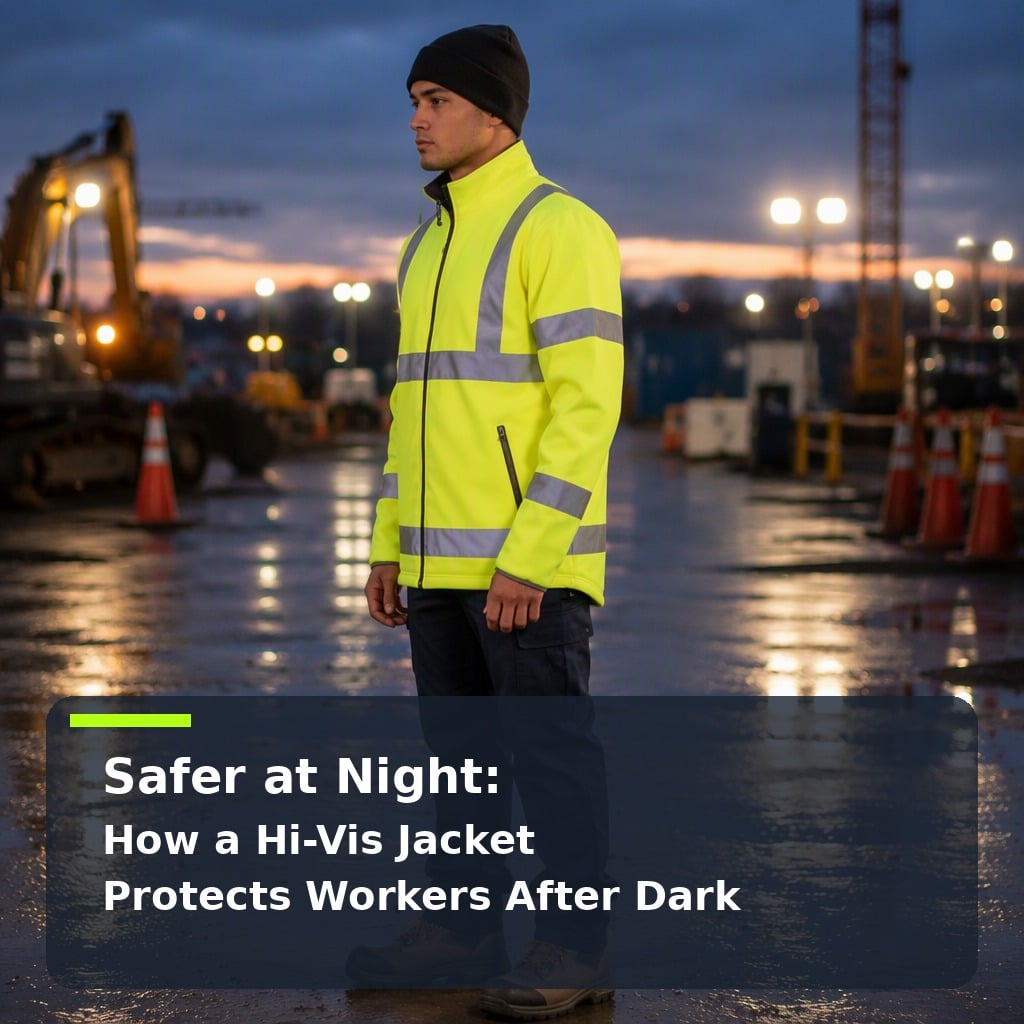
A hi-vis jacket attacks this problem with two technologies working together. The fluorescent yellow or orange background fabric remains conspicuous under streetlights and work lamps, giving the eye a color it does not expect in a night environment. The grey reflective tape does the heavier lifting: it is retroreflective, meaning it returns light from headlights directly back toward the source — the driver. The result: the hi-vis jacket seems to light up as the vehicle approaches, buying the driver seconds to react.
At night, tape placement is not a design detail — it is the difference between being seen and being missed. Retroreflective tape only returns light to the source it faces. A hi-vis jacket with reflective bands only on the chest protects a worker from vehicles approaching head-on, and fails everyone else. Any hi-vis jacket bound for night roads needs more than a front panel.
The layouts that keep night workers safest wrap the hi-vis jacket in bands around the torso, the arms and the hem. Why the arms? Because a moving band of reflected light reads as a human being. Drivers interpret motion instantly, and swinging arms wrapped in reflective tape create a clear, unmistakable silhouette in the dark — the single most valuable feature on a night hi-vis jacket. The hem band matters too: it marks the lower edge of the body, so the driver sees where the person ends and the road begins.
When evaluating a hi-vis jacket for night operations, check the tape in the dark with a flashlight held at eye level. Quality tape flashes bright from across a room. A hi-vis jacket whose tape returns a dull glow in a showroom will betray a worker on a real night shift.
Tape That Survives the Night Shift — and the Wash Cycle
Night work is hard on gear, and industrial laundering is harder still. Retroreflective tape is engineered with microscopic glass beads or microprisms that do the reflecting; heat, abrasion and harsh detergent gradually strip that performance away. A hi-vis jacket that passed its first inspection can quietly fade into an ordinary colored jacket within months. A washed-out hi-vis jacket is still a jacket — it is just no longer safety equipment.
This is why tape durability belongs in every night-workwear specification. Buyers sourcing a hi-vis jacket for crews that launder weekly should confirm the reflective tape on the hi-vis jacket is rated for industrial washing cycles, and should spot-check older garments under a light source.
Warm, Dry and Alert Through the Coldest Hours
Night shifts are cold shifts. Temperatures drop after sundown, night wind picks up, and workers who stand still — at checkpoints, gates and traffic-control posts — lose body heat fastest. A shivering worker is a distracted worker, and cold hands make slow decisions. The right hi-vis jacket treats warmth as a safety feature, not a comfort option.
A night-ready hi-vis jacket addresses this directly. A fleece lining holds warmth through the small hours. A windproof shell with a stand collar blocks the drafts that attack the neck first. And because night work so often means night rain, the hi-vis jacket's shell should be waterproof — yet breathable, so a worker walking a site perimeter does not end up soaked from the inside by trapped sweat. Wet base layers accelerate heat loss, which is exactly the wrong direction at 3 a.m.
The fabric should also stretch. Night tasks are rarely static: climbing onto equipment, waving vehicles through, bending into inspection points. A stretch composite shell lets the hi-vis jacket follow the body instead of fighting it, so the protective layer stays where it belongs. A hi-vis jacket that restricts reaching or climbing gets taken off — and an unworn jacket protects no one.
Smart Storage Keeps Hands Free in the Dark
Fumbling with a phone or a torch in live traffic is a hazard in itself. Well-placed storage lets a night worker keep both hands available. A zipper chest pocket on the hi-vis jacket secures a phone, cards or a radio where they can be reached by feel, without unzipping the hi-vis jacket. Side pockets on the hi-vis jacket hold gloves and small tools the same way. The rule for night gear is simple: nothing essential should ever require a two-handed search in the dark. A hi-vis jacket designed for night crews gets this right; an ordinary jacket never does.
Both fluorescent yellow and fluorescent orange qualify as high-visibility backgrounds, and both keep a hi-vis jacket conspicuous at night under headlights. Yellow delivers the strongest contrast against dark asphalt and night skies, which is why road and highway crews favor it. Orange stands out where the environment is already full of yellow — sodium lighting, warning signage, painted machinery — which is why railways, ports and many plants prefer it. The professional move is to source the same hi-vis jacket specification in both colors and let each site follow its own safety convention, so every hi-vis jacket order ships with the right background for its destination.
The Night-Work Checklist
Before approving a hi-vis jacket for night operations, verify:
- Reflective coverage: bands around torso, arms and hem — a full silhouette, not a chest patch
- Tape performance: bright retroreturn under a flashlight test, not just showroom appearance
- Wash durability: tape rated for industrial laundering cycles
- Cold-shift comfort: fleece lining, windproof shell, sealing stand collar
- Wet-night protection: waterproof and breathable together
- Mobility: stretch fabric that follows climbing, waving and bending
- Storage: zipper chest pocket plus side pockets, reachable by feel
- Certification: documented compliance the buyer can file — not a badge on a hi-vis jacket listing image
The last line deserves emphasis. A listing image with a certification badge costs nothing to make; a certificate the buyer can file is what protects the importer when an end customer audits the supply chain. The same logic runs through every line above: a hi-vis jacket approved for night work should clear all eight, not most of them.
Night work does not forgive weak gear. A hi-vis jacket keeps workers safer after dark through one system: fluorescent background fabric for lamp-lit visibility, retroreflective tape placed around the torso, arms and hem so drivers see a moving human silhouette in their headlights, and tape durable enough to survive industrial washing. Add a warm, waterproof, breathable stretch shell and pockets that work by feel, and the hi-vis jacket keeps a worker visible, warm and focused from sundown to sunrise. Specify the hi-vis jacket that way, test it with a flashlight, and the night shift gets measurably safer.